Tuesday, June 12, 2007
Rent "The Boys of Baraka"

Monday, June 04, 2007
What do you do with "grumpy Jesus"?
This is not warm and fuzzy Jesus. Instead, this is "grumpy Jesus", tired of dealing with people who time after time do not catch what He is teaching. He has just returned from being on the mountaintop talking with Moses and Elijah, and He finds a crowd of people around his disciples who are trying without success to cast out a demon. He calls them a "faithless and perverse generation," heals the boy, and tells the disciples that they failed to bring healing because they lacked faith. We all wondered how Jesus managed to be grumpy and yet not sin in the midst of that frustration.
All of us at the retreat would prefer to skip this passage. To skip the places where Jesus seems disappointed with the disciples, because for us it hits close to home. I often feel like Jesus ought to be disappointed in me and how little I "get it", despite being taught time and again. And I fear that He is grumpy with me because I just don't have enough faith, and passages like this tend to confirm that, if read without a lens of grace.
After putting on the grace goggles, the best I could do with settling this unsettling picture of Jesus is to guess that the disciples' problem was not so much an improper amount of faith, but rather faith that was misplaced, and thus useless. A mustard seed is not very much, and surely they believed to some degree that this boy could be healed. But was their belief placed in God or in themselves? They had done the healing/casting out thing before when Jesus sent them two by two, and I am sure that during that time, they were depending on God like crazy and they saw Him do things through them that they never imagined. So here is round two and the subtle temptation is to go through the motions, trust their experience, and have faith in their ability to get the job done while Jesus was on the mountain. A mustard seed of dependent faith in God can indeed move a mountain, but a mountain of self-reliant faith will produce little lasting fruit besides frustration.
As for whether Jesus is grumpy with us now, I think that He is not. We have been transformed, made into new creations, and we enjoy all the favor and blessing of His righteousness and Right-standing with the Father. He longs for us to have a dependent faith, and urges us to that place of constant trust in the Father, disciplining us and exhorting us from a position of love.
Sunday, June 03, 2007
Things I learned at the grocery store
I started at Aldi, which mostly has its own brand of food (i.e. does not sell the name brands), doesn't have shelves (the items are stacked on pallets) and you bag your own groceries. You also have to deposit a quarter to get a shopping cart and get the quarter back when you return the cart. The cashier scans your items and drops them in a waiting cart, which you wheel to the side when you are done to bag your items. For a family on a budget, I've found no place better for quality and price, and we have certain staples that we always get there (once we figured out which Aldi-brand foods we liked just as well as name-brand). While I was there I saw people from at least four different countries, and you could tell that the people there were thrifty and intent on saving money.
Next I went to Food Lion, the one near my house. This store is OK - it's not lightning fast at checkout, but usually has what you need. The mix at this store was much like the mix of our neighborhood - mostly African American and Hispanic, and the whites who were shopping there were either elderly or seemed to be poor-er. I also bagged my own groceries here (because there was no available bagger, and it gave me a chance to show off my skills honed at the Statesville Food Lion as a bagboy in high school).
Finally I went to the local Taj MaTeeter (Harris Teeter + Taj Mahal = Taj MaTeeter). Their produce section alone was nearly as big as the entier Aldi store. 95% of the shoppers were white, middle-to-upper class. Many of them sipped coffees from the Starbucks in the store as they shopped. At the seafood and fresh meats station, free samples of hot chicken stir fry were being given away, and two butchers stood by to cut meats to your specifications. This was not a grocery store, it was a sensory experience with shopping thrown in. The cashier and bag-girl each talked with me, asked me how my day was and how I was doing, were excited with me to see how much I saved, and urged me to come back again. (I could have picked out my items online, paid for them with a credit card, and had them bagged and waiting for me to pick up, too).
I was struck by the progression of service and quality of experience from one store to the next, and I think I was learning something about values and privilege in our country. If you have plenty of money, you can afford to value a sensory shopping experience over saving money. You can afford to value having your groceries bagged in a courteous and swift manner. It's not wrong to be able to afford that (I certainly was able to, obviously).
As I thought about why I was even in Harris Teeter to begin with (I usually only go there to buy orange Gatorade mix and the buy one-get one bags of chicken), I realized it was due to another small privilege that I take for granted - the ability to play the Grocery Game. I have an internet connection at my house (high speed), the ability to pay $10 every 8 weeks for the Grocery Game service (which you access online), the transportation and time to shop at three different stores in order to get the best deal, and access to simple information, such as the fact that there is such a thing as "the Grocery Game" out there. I am quite confident that if one looked at the demographics of who was using the Grocery Game, it would be largely white, middle-class (and up). There is nothing wrong with that. It's just that the poor are not even aware that this thing exists or have access to the resources to make it happen.
I've even thought about being able to shop at Aldi as being a privilege - there are many in Glenwood who go to Food Lion because it's reachable on foot. Aldi is several miles up the road, meaning a long bus ride or paying for a cab.
I'm not here to make a judgment on those who shop at Harris Teeter or condemn the affluent. I'm not even sure that I have a point except to say that there are all kinds of things we can learn about race and class in all sorts of places, even the grocery store, and I think that there are bigger things at play than I can put my finger on right now.
Thursday, May 24, 2007
Relearning rest
Rest doesn’t look the same as it once did. It used to be that when I needed a break or a vacation, I did whatever I wanted. Slept in. Watched a lot of TV. Took extended times with the Lord. Went to movies. Funny how having three children under the age of four will disrupt such simple and self-focused patterns.
It has taken me a while to accept that rest looks different now than it used to, and I have found that the more I embrace where I am, rather than wish for where I was, the more rest comes.
A few weeks ago we went to the beach (and whoever said “getting there is half the fun” did not spend a full morning loading a Toyota Sienna with luggage, toys, a portable potty seat, and enough finger food to stuff a preschool class), and for the first day I was really frustrated. My kids needed and wanted to spend time with me. My wife needed and wanted time to read a book and relax. And I needed and wanted to rest, which I thought entailed my being alone, doing whatever I wanted, and playing with my kids when it was convenient for me. That expectation was being shattered, and for a while I resented and resisted learning to rest in a new way.
Thank goodness for the love of God for me and in me, as He began to lead me in letting go of my way and submitting to the season of life that He has for me right now. My children won’t be this little for very long. Precious times of playing in the sand, reading books before bedtime, fixing peanut butter and jelly sandwiches will be gone before I know it. And in loving my wife and kids, and being loved by them, was great rest. I came back from the trip refreshed and thankful.
This week, post-Rockbridge, has been a similar experience. There is a part of me that longs for the days when, as a single staff, the “comp-week” after Rockbridge was filled with, well, me-time. But this week I have been to the museum with Psalter, to the zoo with Eliza, Psalter, Diane, and Jacob, and to story time at the library with them all. God is redefining rest, and I learn that the most rest comes when I simply cooperate and receive what He has and find Him in the midst.
Friday, May 18, 2007
Ruined Again
To me this is such a picture of what the Church should look like, worshippers of different races in one place, leading one another to see a bigger and bigger picture of the Lord Jesus and different ways to respond to Him in love. Perhaps it’s just that I have a heart for multiethnicity (ME), so I enjoy things like this. But I doubt that all 400 of the college students here at camp had ME as a high value or had even experienced worship like this anywhere except maybe Urbana. Yet they have embraced it and they worshipped God, whether or not they understood the words they were singing (we also sang this week in Hebrew, Korean, Tswana, French, Spanish, and Mohawk (Native American). I have seen African American students worshipping their heart out to “white” contemporary Christian songs and white students making up dances to gospel songs. This generation is so open to being shown new ways to praise God.
And so now it is hard to go back to my home church where our worship music is nowhere near as diverse. This doesn’t mean that the music is bad or insincere or that I am being critical of what is there. It’s just that being here with IV reminds me of all the worship forms that are not at my church (or at most churches), and I really think that when our worship is more monocultural, we are missing out on seeing and experience more of God. I know that in a few weeks I will reacclimate myself to worship that is more main-stream evangelical, and I will enjoy meeting God in that form, while still hoping and waiting to see the Church (and my church) move towards being a place of diversity in unity as we worship one Lord through many languages, styles, and expressions.
PS For a taste of what we were enjoying, or to even begin a journey of diversifying your own worship experience, order a copy of One Calling, Live, the worship CD from Urbana.
Saturday, May 05, 2007
Remembering the Intimidator

Tonight Diane and I went with two friends to see Dale, the documentary about Dale Earnhardt Senior (to see the trailer, click here ). To get tickets I had to go and test drive a Chevy (I drove a $31,000 Silverado pickup), and I have to say that movie was WAY more than worth the time that it took to do that test drive. Whether you are a race fan or not, the story was compelling enough that you would enjoy yourself the whole time, and for me, it really was one of the most enjoyable movies I have ever watched. The Carolina Theatre here in
The things that I appreciated about the movie were the ways that it showed what a regular, “everyman” that Dale Sr was, and what a great sense of humor he had. On the track he intimidated and dominated, and off the track he fed his cows and farmed his land. There were also some very sad and poignant footage of Dale Junior as a kid, watching his dad from afar at the track and in victory lane, longing to be noticed and invited closer but not receiving that. It made me sad for him, and I could see why he was so driven to succeed in racing, seeing it as a way to get closer to his dad. I also see the everyman quality in Junior today – he doesn’t seem to take himself too seriously, takes racing for what it is, and shoots straight with people.
I can understand now why Teresa Earnhardt is reluctant to sell the majority share of DEI to Dale Jr, too. She was Senior’s business partner, helping him build that company from the ground up, and I think that she really had a lot to do with its success. To put herself in a minority ownership position after all that would be hard.
Thursday, May 03, 2007
It's Bigger Than a Fence
See, our garden is up and running with 20 plots built, 4x20 feet each, and people are planting and things are growing. But two weeks ago the city began construction on the fence around the garden and the poles were eight feet high! I was concerned. An eight-foot chain link fence does not say, “Welcome to our garden.” It says either, “Keep out!” or “We’re afraid of you!” or both. I mentioned this to my new friend Todd, who is very justice minded, and soon emails were flying. Todd began talking with plot holders, the people from the city parks division and county agricultural extension, as well as the neighborhood association leadership, and tonight we had a long discussion as a group about the fence.
It was a good discussion, but it was interesting to hear the opinions of each side of the argument. There were people saying, “They will vandalize”, “They will jump the fence,” “There are drug dealers out there in the park.” “I’ve seen them jump an 8-foot fence like it was nothing.” Then there was us saying, “Some of those homeless/drug dealers/prostitutes are our friends, and those who aren’t, we want to try to welcome them, not run them off. Plus, all our neighbors who come to the park don't fall into those categories.”
For me, I am not worried if people take my cucumbers or if they walk on my plants. I am not concerned with vandalism of the tool shed. A community garden is designed to build community, and it’s hard to lean over an eight-foot fence to talk with your neighbor.
But the issue is bigger than a fence. It’s a neighborhood in transition, trying to figure out how to build community across race and, especially, class lines. It’s prejudices and ideas about race and culture framing how we perceive the world around us. It’s the language of “us versus them." I’m not trying to cast the people on the other side of the fence (har har) in a poor light; I really think that they are sincere and are working out what they think a neighborhood should be.
This issue points towards gentrification, towards people with power due to race and class being able to move others on without much of a fight, towards those with a voice sticking up for those who don’t. It’s bigger than a fence. And it’s a conversation that will continue, that needs to continue, for a longer period of time. It was great to talk with my neighbors about this and to have a dialogue about a small thing that is actually very important.
For the record, we held a vote as to whether to lower the fence to 6 feet or 4 feet, and my group, the four-footers, lost 13-9.
Tuesday, April 24, 2007
Favorite-ism
In my Grace Life courses, they say that each person has three core lies that have shaped our life apart from Christ: a lie about God, a lie about ourself, and a lie about others. As we understand those lies, we begin to see a lot of what motivates us to live and act the way that we do in our flesh (flesh being dependence on self to meet our needs rather than depending on God to do that).
I remember when I was 10 or 11, my family got a new puppy, and I asked my step-mom if I could be the one to feed it. She asked me why, and I said, “I just want to be someone’s favorite.” At the time, see, I had at least one, if not two, baby sisters (I can’t remember exactly how old I was) and I am guessing that I was dealing with adjusting from being an only child for 10 years to being one of two (or three).
The story about the puppy is kind of cute and bittersweet – what kid doesn’t struggle some when the new baby comes around? But I think that this desire to be a favorite has continued to simmer in me, and may even be one of my core lies. I want to be significant and accepted (other words for favorite), and I depend on many different things to meet those needs. Sometimes it’s work, and so God gives me the gift of failure, like when the IV chapter I staffed went from 150-plus students down to 30 in a span of three years. Sometimes it’s “stuff”, so God gives me the gift of dissatisfaction with my “toys” that I buy.
One thing that I began to think about while talking with them and praying was that maybe “favorite” is a term that God would rather us not use. Favorite implies ranking, puts people in classes and orders and elevates them on worthiness to be loved. God would rather us love and appreciate people uniquely, connecting with them on different levels of depth and interest, appreciating them in the moment for who they are and what our relationship is. He also reminded me, again, that my significance is only in Him. Not in people. Not in work. Not in stuff. Sadly, I also realized how long fear of not being the favorite has tainted so many relationships, leading me to be selfish in some, to run from others, to be fearful in still others.
I don’t think that the Father, apart from Jesus, has a favorite in His Kingdom. Except that I am His favorite me. You are His favorite you. Uniquely and wonderfully made, not ranked against other children, not judged or justified on a sliding scale. He simply and consistently loves, who we are, as we are, giving us significance and worth through Christ and the price He paid on the cross.
Sunday, April 01, 2007
An unblievable morning
The program was with The Richard Petty Driving Experience, and after some instruction I started out with a 3-lap ride-along, driven by one of the Petty instructors. I was able to get in the #8 Budweiser Chevy (just a nice bonus), and the acceleration in that thing was astounding. Going into the turns took your breath away as the g-forces pulled you up the track towards the wall, yet the car just stuck and went on around. I imagine that we went at least 165 miles an hour, and it was as smooth as can be. My legs were weak when I got out of the car, but 3 laps was nowhere near enough.
Soon it was time for my 8 laps driving, by myself (I thought that there was going to be an instructor in the car with me). They make it very easy for you - simply follow the pace car in front of you, staying right in their tracks. They pick the best line around the track, and as you show them that you can keep up, they will speed up. At first I was just amazed to be driving - it seemed surreal, and I had to remember that they wanted me up close to the pace car. As we got going faster and faster, all I could do was grin and yell for joy. It was not very hard to control the car - they are built to go fast and turn left, after all. But it was a thrill to go that fast, that near to being out of control, yet feel like the car would do whatever you want.
The image that sticks in my head the most is being in the middle of turn 3 - you just feel swallowed by the track because the banking is so high - you see pavement above and pavement below. (At the start of the day they took us around the track in a 15-passenger van, and at one point they stopped in the middle of a turn, and you just sort of hung there sideways).
As I got more comfortable, the speeds picked up, and it began to feel like I was really doing it. They had rules about when to get out of the throttle (there were cones on the track for when to give it gas and when to ease up in the turns), and the longer I went, the harder it was to hold off on mashing the gas until getting to the proper cone.The power that those cars have is unreal. In my car, you can be going fast and give it gas and it takes a little while to respond. There is no wait time with these. You hit it, the car GOES! After driving, I was tempted to think, "That's not so hard, what they do each Sunday." Then I remembered that their top speeds are more than 60 miles an hour faster, and they do it with 43 other cars all around them. Not that easy.
I noticed that a lot of the folks there had their friends/family/wives take a ride-along, and so I asked Diane if she wanted to take a ride-along. How often would we have this chance? So, after thinking a moment, she took me up on it, signed up, and soon was off for her own ride. I was glad that she was brave enough to try it, and she had a great time.Jacob was there, too, and unbelievably he slept through most of it! My friend Chris has a great blog post about taking his son to a race, and his contentment in noise is a picture of our opportunity to rest in Christ.
So, thank you to everyone who contributed towards this awesome gift. Special thanks to Diane and to Brian Walker, who organized the gift and who went with me to cheer me on. I hate to say it, but I think I need to do this again someday!
Monday, March 26, 2007
Shooting in the dark
The first time I did this was in 1984. I was eight years old, and the Tar Heels had just lost to Indiana. There was no reason that this Indiana team should have beaten my Heels that year, what with Michael Jordan and Sam Perkins on the team. I had been allowed to stay up to watch the game, and when it was over, my dad suggested we go shoot some baskets in the driveway. When you're 8 years old and already up way past your bedtime, the chance to play 'ball with your dad at night was a rare treat. So we went out and shot, the floodlight casting long shadows. As far as I can remember, every year since then, that's how my UNC basketball seasons have ended (except for the years when I saw their Final Four losses in person).
I remember getting yelled at by an RA at Carolina in 1995 when the Heels lost to Arkansas in the Final Four because we were shooting on the Avery Dorm court after quiet hours (who was studying at 11:00 pm on a Saturday, especially with football players carousing in the balcony, apparently {and inconceivably} celebrating the loss?). I remember shooting in the dark in 2004, having given up TV for lent and thus relegating myself to trying to not listen to the Heels game against Texas (I dunno, I figured that listening to them was cheating or something), and hearing Rashad McCants' tying three fall short, went straight to dimly lit courts of Lake Daniel Park.
Tonight, more than any other night that I can remember, I was shooting in a fog. The way that Carolina lost, letting a lead slip away bit by maddening bit over the course of 7 minutes, letting a game that we had led pretty much from the start slip away because we could not get the ball in the goal, it just stunned me. I couldn't talk. I wasn't angry. I didn't want to throw anything. It just didn't seem real. Still doesn't.
Now there's 8 long months until the 2007-08 season starts, and I'm uncertain as to which players will still be on the team then. Maybe it's time to change my homepage from Tarheelblue.com to NASCAR.com. I just don't have the heart to do it yet.
Thursday, March 22, 2007
A prayer for Glenwood, and beyond
15-20Yes, weep and grieve until the Spirit is poured
down on us from above
And the badlands desert grows crops
and the fertile fields become forests.
Justice will move into the badlands desert.
Right will build a home in the fertile field.
And where there's Right, there'll be Peace
and the progeny of Right: quiet lives and endless trust.
My people will live in a peaceful neighborhood—
in safe houses, in quiet gardens.
The forest of your pride will be clear-cut,
the city showing off your power leveled.
But you will enjoy a blessed life,
planting well-watered fields and gardens,
with your farm animals grazing freely.
Justice will move into the badlands desert
Right will build a home and where there's Right, there will be Peace and what does Right bear? Quiet lives and endless trust.
Are peaceful neighborhoods, safe houses, quiet gardens only for those who can afford them? Of course not. And this garden, I hope, is a part of bringing Right to Glenwood, not to exclude the poor but to bless them, as well as everyone who makes up our community.
In a sermon by Ray Bakke (an urban ministry veteran and "grandfather" in this movement) he recounted a conversation he had with some evangelical leaders in Chicago. They were hearing about his ministry, and one said, "When you talk about sharing the gospel with people in your neighborhood, I get excited, but when you talk about changing systems and things like that, I get uneasy because it sounds like a social gospel." This particular man lived in the suburbs (and there is nothing wrong with that, let me say up front), and Ray asked him why he chose the neighborhood that he did. The man proceeded to list the advantages - safety, good schools, great healthcare options, peace and quiet, and more. To which Ray replied, "All of those reasons that led you to choose your neighborhood are social reasons; you believe in a social gospel as much as I do. Everyone wants those things, but those who have them often say that those who don't should just be content to not have them and that we shouldn't get involved in those social issues." (this is a less-eloquent paraphrase of his story).
As Christians, whether we move in to hard places or not, I think we are called to bear the progeny of Right and work for peaceful neighborhoods and well-watered gardens for all, using whatever gifts and influence that we have on behalf of others, and I have seen many wealthy Christians in Greensboro who don't live in the harder parts of town do just that. I just think that in general it is easier to care about these things when you live on the unpeaceful street, because you are working not just for others but for your own living space.
Interestingly, I feel like my neighborhood association in Glenwood is working for peaceful streets and quiet space, but I fear that this will happen at the expense of the poor. Unless we plan now and make room for Right, for Justice, the peace and quiet will be affordable to fewer people. When others are excluded because they are forgotten and not fought for, that is not God's plan for Shalom, true peace and right-living. I don't think that my neighborhood association is out to get anyone or exclude anyone intentionally - many of them are sympathtic to this issue and sincerely are considering the implications, but displacement is going to happen unless there is intentional and creative planning and leadership.
Wednesday, March 21, 2007
Allow me to be cynical for just a moment

But to me this seems like yet another attempt to remove ourselves from the world, making ourselves insulated and isolated from those who might think differently than us or have conflicting values. It's all the same stuff as regular YouTube, only it's sanitized, Christianized, and mostly irrelevant to people who don't know Jesus. It makes me sad that tons of Christians out there are going to celebrate this site as a positive witness for Jesus on the internet, not realizing that for the most part non-Christians won't darken the virtual door of Godtube, unless it is to mock or shake their heads. Why do we as Christians continue to struggle with relevance, lacking creativity and drive to engage the world with excellence on the world's turf and terms? It's not easy, and it's certainly simpler to spoof and parody in Christian-ese and know that it will be accepted and liked by people who speak the same language. Sigh. Maybe I'm being too hard on this instance.
Tuesday, March 20, 2007
Couldn't be prouder
Each week of spring break we took the Salvation Army disaster van out on a Tuesday night to visit homeless men and women in the city and take them food and drinks. The second week our first stop was right across the street from Greensboro Urban Ministry, and because the weather was warm, the overflow beds were no longer available. Result? There were lots of homeless people hanging out on "the block", and so when our truck rolled up, they all came across the street. Just a few at first, then more and more. And as the first group came, I was across the street from the college students talking with a couple of men that I had met in previous trips out with Nightwatch.
So, there I was, the most experienced in this type of situation, all the way across the street, and a group of 10 college students, who were expecting to talk with maybe one or two homeless people at a time, on the other side with a group of 10 homeless men and women. When I got to them, the students all looked a little stunned, but as I reminded them to simply talk and pray with each person and led them in getting food and drinks out, they recovered and began to really minister. They laughed and talked with our friends, and each person who came was warmly welcomed and prayed with. Students were speaking truth about the Lord and were offering friendship, crossing racial and class and cultural lines, not necessarily with ease but with purpose and love.
While I have grown to realize the truth that the homeless are real people with dignity and real stories to their lives, that has taken time and many relationships and conversations. For most of the students, this was their first time confronting the stereotypes that many of us have, and they did it so well.
Monday, March 05, 2007
All the Pieces Coming Together
This, however, is changing. God is beginning to move people into place to transform this ministry into one that is effective for the kids and more enjoyable for the tutors. He brought Regina Clark, a businesswoman who specializes in developing an infrastructure to make vision come to pass. He has brought Millie Smith, who has a degree in physical education, and works for a state organization that promotes health and physical activity. Millie now leads an organized play time for our kids and tutors each Monday, which has increased relationships and teamwork amongst them. God brought Jeb Burns, a graduate school education major who is a parent of middle schoolers and who also has a passion for middle schoolers, and he is helpind bring an organized curriculum to that portion of our program. God enabled Melissa Lewkowicz to come on as a paid staff with InterVarsity as an administrative assistant for GUPY and this program. God gave John Freeman, the middle school pastor at our church, a heart for the middle schoolers in our program, and so he serves one day a week. God has brought 7 adult tutors from our church and other churches, which has given maturity and presence to our class rooms. God has given us a tremendous resource in a reading teacher from Guilfor County Schools who is teaching us about discipline and how to help kids read.
Adding these pieces to what we had already has begun to transform our program. Regina has helped us implement a regular schedule each day, which the kids are responding to in a great way. The play time has taught kids and tutors to play together. And there is a calm and an order to our time that there hasn't been. Thus the tsuhami feels more like and regular tide, with some occasional rough seas from time to time (like today when one of the kids stopped up all the sinks in the boys bathroom and turned the water on, resulting in about 1.5 inches of water on the floor and some water in the ceiling below). God is positioning us to have a program next year that is going help the children tremendously.
Sunday, March 04, 2007
Yikes

Diane and I had the privilege of going to the UNC-Duke game and had a great time being together and watching the Heels win. However, I have not experienced mass anger like there was in the Dean Dome after Tyler Hansbrough was bloodied by Gerald Henderson.
There was a moment where I thought things could get ugly, and I wondered if the refs would just get Duke off the court and call it with 14 seconds left. No one threw anything, no one went on the court. But the place was boiling. I felt bad for Henderson - he's just an 18-year-old kid, getting booed off the court and probably being called who knows what. And it was disappointing to feel like the mood at the end was more anger than celebration.
But this has now supplanted the "Bloody Montross Game" of 1992 as the game that UNC fans will remember and point to when thinking of this rivalry.
Incidentally, I have watched about 10 replays of the hit, and while I don't think Henderson was aiming for Tyler's face, he was coming in to commit an aggressive and hard foul after starting the play at the foul-line extended part of the court, and he was bringing his arm down hard, not swatting at the ball and not simply falling into Tyler.
I was disappointed by Coach K's implication that the injury was partly Roy William's fault for having Tyler still in the game with UNC up 11 or 13 and 14 seconds to go. 1) Coach K was calling timeout after his team scored to cut the lead to 13 with 50 seconds left. Certainly not giving up. 2) A sub had been waiting at the table for Tyler when Bobby Frasor was at the line, and Fraso simply missed the foul shot and Tyler got the rebound, setting up his ill-fated free-throw. See this espn.com article for more.
http://sports.espn.go.com/espn/columns/story?columnist=forde_pat&id=2787890&sportCat=ncb
Friday, February 23, 2007
A sad morning in court
The Assistant DA who was running the courtroom I had to go to (our friend's charges were being dealt with in two separate court rooms at the same time - how does that work?) made no effort to be pleasant. It was simple traffic court, but she made no ability to speak with kindness. It was clear that she wanted to establish that she was in charge and her rules were the only ones that counted. I understand a need for order, but her rules became laws that were immovable. For example, she misread the name of one woman sitting next to me, and so the woman didn't catch it. Realizing that the DA might have said her name but mispronounced it, she asked her if she could pause and repeat it (the DA was two names down the list by then). The DA said she could not and would not, and that the woman would have to wait. She did not say it kindly, and she seemed to enjoy being in charge. Thankfully, a lawyer later helped this woman, finding her case in the pile and giving it to the DA.
No questions were permitted, and people were treated like an annoyance. Will and I received the same treatment upstairs in the DA's office, as we had gone up to see if we could get the case continued without sitting through the docket. Another Assistant DA came out to see us and said, "Who are you?" in a way that made me feel like I was very small. When we explained our situation he told us just to go to the courtroom and listen for Kevin's name, and when we asked what we were to do then, he began walking away and said, "Just go down there." Will was in his courtroom, and said that he was extremely rude, telling people to shut up and asking who gave them permission to speak.
The thing about going to court is that it's not very intuitive for most defendants because they/we don't spend a lot of time in that place and culture, and if you don't know what you are doing, it's hard to play the game. I see why so many people hire lawyers because it's tricky and time-consuming for an average person to navigate the legal system. And unfortnuately, the rules of the courtroom game don't permit you to ask questions without being treated like an annoyance. Sure, the DA lays down some ground rules before calling the calendar (say either "guilty", "not guilty", "continuance", or "attorney" when you hear your name called), but what happens after that is for them to know and you to find out. For example, I said "Continuance" when my friend's name was called, and then they took out the stack of continuances and began to read the names and assign another court date. But there was a small stack of "continuances" whose names were not called, and were just left there. My assumption is that my friend has overextended his continuance graces, but that was never explained or addressed or mentioned, and I dared not ask.
The ADA also treated the room like a group of 5-year-olds, telling people to sit down rather than stand in the back, which is fine, because those are the court rules, but her tone and demeanor was that of a teacher talking to a group of Kindergardeners who had never been to class before. What I sensed from her was fear and control - she drew these really fine and tight lines and there were no exceptions because unless the laws/rules were kept to the letter, who knows what might happen? (sarcasm) People who had the audacity to challenge those by asking a question or not getting them right the first time were shamed. I also felt that she enjoyed being charge, but hated her job and disliked all the people there who were overloading her docket and were probably up to no good anyway (note: she did not say any of this - this is my perception).
Looking around the room, the defendants were 98% black and Hispanic. The people in charge up front were 99% white (I saw one black attorney) and mostly male (the ADA in my court room was a woman and there was one other woman lawyer). The power dynamic was clear - there was a way of talking, a way of operating, and if you didn't know how to talk and operate in that way, you were in trouble. At first I thought of this as a racial divide, but really it was a class divide. Now, race and class are not easily separated here in Greensboro - the have's tend to be white and the have not's tend to be black and Hispanic - but Will helped me clarify that this was primarily a class gap. The ADA was communicating in a way that was not familiar or effective to the class/culture mostly represented in the courtroom, and the defendents' way of communication was not acceptable to her, for the most part.
It made me sad that our legal system has created a dependance on lawyers not to defend
us but to play the game for us because it's too hard to play for ourselves, and to see that the racial makeup of those on trial was overwhelmingly black and Hispanic showed that our society is still slanted along lines of race, class, and power.
Wednesday, February 21, 2007
From the mouths of babes 2
Tuesday, February 20, 2007
James 1:5-8 - Belief, Doubt, and Prayer
Alex wrote: what did you/your small group do with chapter 1 with the part where God gives genrously to all without finding fault UNLESS you're a doubter, in which case you shouldn't expect to receive anything at all. It seems that's a pretty significant blockage...and I'm having a hard time finding a way around it.
This is indeed a troubling passage when taken at face value. It seems that it's all up to us - God will give generously, but with a condition. But, as Alex knows, we have to use the full counsel of Scripture to interpret passages that are confusing or don't seem to jive with the God we know, and so that is where I started in thinking about this. If this verse were true at face value, then the man whose son was possessed by a demon in Mark 9 was in trouble, because his "prayer request" for healing was followed by, "I believe; help me overcome my unbelief. "Sounds like there is doubt there to me. Yet Jesus healed him, generously.
The NIV Bible Commentary says this, "This father was not oscillating between belief and unbelief. He desired to believe--and even asserted his belief--but because he felt keenly the inadequacy of his faith, he asked for help in believing. He was not facing both directions at the same time like the "double-minded man" of Jas 1:8. In spite of his conscious weakness, he had set his heart to believe. And Christ responded to his faith and healed his son."
There is also the passage where Jesus tells us that if we have a mustard seed faith, we can move mountains, which once led me to despair. If all it took was a mustard seed to move a mountain, I must have incredibly little faith, because I had not moved any mountains. But perhaps Jesus' words were less a commentary on the required amount of faith, but rather on the powerfulness of the faith's object - that God is so mighty that He takes the mustard seed that you give and moves the mountain.
We also have to let verse 5 inform 6 and 7 - God's gives generously without finding fault. We as Christians are in Christ, and we have sonship relationship with the Father. He loves and longs to be generous to us, which Eugene Peterson shows well in his Message translation of these verses:
If you don't know what you're doing, pray to the Father. He loves to help. You'll get his help, and won't be condescended to when you ask for it. Ask boldly, believingly, without a second thought. People who "worry their prayers" are like wind-whipped waves. Don't think you're going to get anything from the Master that way, adrift at sea, keeping all your options open.
My friend Macon came up with this a helpful analogy (or he borrowed it from our favorite theology professor, Gary Deddo) to talk about the role of faith in prayer. Macon asks the question, "How much is enough to get my prayer answered?" So, does God require that I be 100% certain? How about 98%? Or is it just a majority, like 51% sure that tips the scales on my behalf? If I have 49% or less, am I unable to get God to move? Knowing my own heart, there have been few, if any, times that I have had 100% faith when I prayed. On my BEST prayers I've been in 90% range, I think. Yet God has answered. God has moved, using the the faith that I offered. See, Jesus lives in me and He lives for me. I no longer live, but Christ lives in me. I no longer pray, but Christ prays in me. And so I offer Jesus my 30% faith and He takes that prayer, perfects it, and offers it to the Father on my behalf as a 100% prayer.
It seems that Scripture is full of doubters and strugglers, men and women who did not have 100% faith, and yet God still moved for and in them. Think about Gideon's fleece, John the Baptist's father, Sarah's laughter. It seems that God is not limited by our faith, or lack thereof, in the way that we think He might be. Yes, faith is important. But God can work with far less than we offer, and He answers feeble prayers just as much as He answers confident ones. Prayer being answered is not about our rubbing the magic lamp just right so that the genie comes out and gives us our wish. It is a recognition of need that we cannot supply, and whether we are 100% certain that God will come through and meet that need as we see fit, we still recognize that we need help and are asking with all the faith that we can muster.
So, all of this gives me a new lens through which I have to read James 1:5-8. One key phrase in this passage that the NIV Bible Commentary points out is, "he is unstable in all he does." The double-minded man is not someone who prays to God and has some doubt that He will answer, or someone who has imperfect faith. Rather all that the double-minded person does is characterized by flip-flopping and indecisiveness in their relationships, their work, their walk with the Lord.
In sum, I think that when I operate as a person under the Law, James is very troubling. The Law view of prayer would say that there is a standard that I have to meet in order to unlock the power of God. But Jesus has met that standard for me, and lives that standard in and through me now that I am in Christ. I am not a double-minded man, because I am in Christ and I have the mind of Christ (Col. 2:16). I am not abandoned to my weak faith, but can in all things depend on Christ, crying, "I believe, Lord help my unbelief."
What do you think?
Sunday, February 18, 2007
Overwhelmed for dependence's sake
So today I was reading in 2 Corinthians 1:8-9 which says, "We do not want you to be uninformed, brothers, about the hardships we suffered in the province of Asia. We were under great pressure, far beyond our ability to endure, so that we despaired even of life. Indeed, in our hearts we felt the sentence of death. But this happened that we might not rely on ourselves but on God, who raises the dead."
There is a rumor that makes its rounds in Christian circles that says God won't put more on a person than they can handle. If that was true, then what happened to Paul? He was under pressure greater than his ability to endure, clearly more than he could handle, and he said that God let that happen in order to create dependence, not relying on himself but on God. (This thinking is actually a mis-application of 1 Corninthians 10:13. which says, "No temptation has seized you except what is common to man. And God is faithful; he will not let you be tempted beyond what you can bear. But when you are tempted, he will also provide a way out so that you can stand up under it.")
It seems to me that God constantly gives me more than I can handle. Life is more than I can handle - it was too much when I had no kids, when I had one, when I had two. This week I feel like I am at the end of my patience. I feel like crying sometimes for no reason. I feel distant from my wife as each of us is preoccupied with caring for the little ones. All this is happening that I might not rely on myself, but on God, and until today I was trying everything but, from buying and selling cell phones on ebay, to checking email, to angrily throwing a bowl full of cereal and milk into the sink and storming off the bedroom when Eliza informed me that she didn't want milk on her Cheerios.
If I could handle life, I would not need God at all. I believe that God's ultimate purpose for all people is for us to depend on Him for all things. And so He often gives me more than I can endure, taking me to the limits of my patience, ability to love, time, and energy so that I have to say, Lord, I give up. I need you to live through me. Reconnecting with Him through Scripture and worship has reminded me that relying on Him is life, the only life and hope that I have.
Tuesday, February 13, 2007
James Thoughts, Part Three
Context, Context, Context
James 4:2b says, “You do not have because you do not ask God.” This has been pirated by "name it and claim it" folks who use the verse to put the fault/potential on the Believer to get God to do what we want Him to do. You simply must ask, with faith. If you don’t have insert thing here, it’s because you are not asking. But the context for this verse is so important, because the issue that James is addressing is not faith (or lack thereof) but dependence on God. People are trying to meet their own needs by fighting and quarreling, coveting and killing. They don’t have because they are trying to supply their own needs rather than asking God, depending on Him to supply their needs. Their motives of independence and self are revealed in verse 3, when they are called out for spending their blessings on themselves.
Smackdown… Or Is It?
So in 4:4-5, it seems that James is finally letting them have it – now they can feel nice and guilty for being such rotten Christians. Calls them adulterous people who are making the Spirit of God jealous. Go ahead James, land the knockout blow! But then, in verse 6 it says, “But He gives us more grace.” They’ve blown it, raised God’s ire – adulterous people for crying out loud. This is true for all of us. BUT He gives us more grace. If you operate in independence (pride), God opposes you. But if you are dependent (humble), He gives you more grace. Humility and dependence begets grace.
Monday, February 05, 2007
Jacob Pictures
Sunday, February 04, 2007
From the mouths of babes
Saturday, February 03, 2007
James Thoughts Continued
Mercy Triumphs Over Judgment
James 2:12-13 says 12 Speak and act as those who are going to be judged by the law that gives freedom, 13 because judgment without mercy will be shown to anyone who has not been merciful. Mercy triumphs over judgment!
James 2:22-23 is a call to be do-ers of the Word, not just hear-ers. A worthy call. I think that we as Christians should be authentic, living what we say we believe (I believe that Steven Curtis Chapman said it best with, “It’s got to be true, I gotta’ be living’ what I say I believe, even if nobody but Jesus is watchin’ me. G-O-T T-O-B T-R-U.”). However, there is a lens of law and a lens of grace. Law says, “Do it because I said so, and if you don’t you don’t measure up.” On first glance, that is what James is saying. But grace says, “I have given you all you need to ‘do’; I have loved you first; therefore ‘do’.”
James 2:25 gives that grace motivation. If you look intently into the perfect law that gives freedom (there's that concept again!), and continues to do this, he will be blessed in what he does. There is a correct order – look into the law that gives freedom, and then be a do-er of the Word. If you “do” from the position of freedom, there is blessing.
Coming up next: Context, Context, Context! and Smackdown... Or is It?
Thursday, February 01, 2007
New Eyes For the Book of James
James is About Grace!
Note: OK, at the end of this I did check a commentary, and got some good stuff from it!
So, the first verses that really jumped out to me were 1:25 and 2:12; each of them referred to a law that gives freedom, which has never seemed like a concept that makes sense. Laws don’t give freedom (I thought) – they bring bondage (when you break them); they restrict (when you keep them), and even when you keep them you can fall into the temptation of pride in how well you keep the law on your own.
Sunday, January 28, 2007
Jacob Marshall Benbow is here!
What a wonderful day it was yesterday, as Diane delivered Jacob at 6:42 pm. He has brown hair, giving us a brunette, a blonde, and a red-head, and he is very laid back and sweet. In fact, he is so laid back that Diane is having trouble getting him to wake up and eat! Check the video below for Eliza and Psalter's first meeting with Jacob. Will post some photos on Flickr as soon as I figure out how to make a new grouping on the site.Friday, January 26, 2007
Sunday, January 14, 2007
A book that lives up to its name
As I was reading Practical Justice: Living Off-center in a Self-centered World by Kevin Blue, I had the thought, "Man, these chapters are so practical." Then I remembered that the book was living up to its title, and really appreciated the skill and intent of the author. In yet another super book from IV press, Blue (who is a colleague of mine in InterVarsity Urban Project circles) clearly, prophetically, and theologically exhorts Christians to see the Bible with eyes of justice, and to live out the teachings and call of Jesus. The thing that makes this book such a great resource is that Blue doesn't just talk theory, but rather gives simple and practical next steps, some of which are very challenging and some of which are accessible to anyone. For example, in his chapter "Giving a Man a Fish" which teaches on meeting immediate needs of the poor and homeless, Blue gives four pratcitcal steps. 1) Buy a homeless person food and sit and eat with them and offer to pray with them about their circumstances. 2) Volunteer at food pantry or serve at a homeless shelter. 3) Visit a convalescent home that houses residents who are economically struggling. 4) If you live in a less-urban area, identify the pockets of poverty that certainly exist and ask God how you might be used there.Blue also made me squirm with conviction a couple of times. In particular his chapter "Should I Help?" adddressed some of the excuses that I often make in not helping people. Here are the paragraphs that messed with me.
"Give a man a fish and he'll eat for a day. Teach him how to fish and he'll eat for a lifetime. Therefore don't give him a fish." This is the cultural mantra of much of the middle and upper class. While Jesus says directly to give to those who ask (Matthew 5:42), we are encouraged to interview, be suspicious of, and ultimately not give to beggars. Why? It seems that we think people are poor because they ought to be. Or is it a disease that can be caught if you associate too closely? We are taught that those who are poor don't want to work, are manipulative, don't care about themselves or others, are criminally dangerous, or are unmotivated to do better. Yet Jesus doesn't mention any of these conditions as a reason not to give to someone in need.
Now, Blue has more to say in this chapter, and he is balanced and grace-filled as he speaks truth. But he calls Christians to embrace God's heart of justice and show us ways that we can participate in that, and he writes to exhort, encourage, and challenge. I highly recommend this book.
Thursday, January 11, 2007
If I were really, really rich for just one day...

I would buy one of these in heartbeat.
And give lots of money to starving kids all over the world.
I would most likely be donating said money via previously coveted -I mean mentioned - iPhone, which has internet capability. So I would donate money while listening to songs (or watching a video) and fielding a phone call, but not while I was driving.
Monday, January 08, 2007
My kind of church
In the room were single moms and singles without kids. Young married couples with babies, and older marrieds whose kids were in college. There were poor and moderately wealthy, black and white, struggling and established, many walking with Jesus and some teetering on the brink of falling away. I watched Eliza and Psalter playing with some of the kids who come to tutoring and felt the ease with which everyone in the room interacted and loved each other, not dwelling on racial and class lines. The community love there was genuine, not a forced attempt at reconciliation or a sense of the haves giving to the have nots. And I couldn't help but think, "Now this is church."
That is not to say that my worship experience earlier that day was invalid or not spiritual. I was fed from God's Word, I worshipped with Brothers and Sisters in Christ. But as I continue to read Scripture with the lens of reconciliation and transformative justice in place, I can't help but believe that church is should be more than homogeneous, more than based on worship preference, more than good sermons. It should be a place where the boundaries of our culture and prejudices are overcome by love and good deeds, by a commitment to relationship for the long hall, and by a commitment to gathering people of varying background, cultures, and financial means.
And that gathering of a diverse people should be a more concentrated gathering than what I typically experience. There certainly are people of several races and cultures who worship regularly at my church. There certainly are people of varying economic levels in service on Sunday. But they are scattered, not concentrated, and are therefore often overlooked and unheard, and their transformative presence is not felt by the Body at large.
I am both sad and thankful for the gift of our time yesterday. Thankful because it was sweet to my spirit and gave me a hopeful picture of a beautiful church. But sad because most of our friends from Glenwood who were at this party do not attend our church on Sundays, and I wonder how long it will be until yesterday's snapshot becomes a living reality.
Wednesday, January 03, 2007
Getting Reconciliation Blues

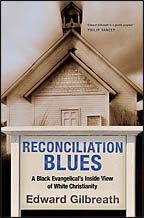
I can count on two fingers the number of books that I have read on one day – The Hobbit and, now, Reconciliation Blues by Edward Gilbreath. Granted, I read this book over the course of a day of traveling from St. Louis to NC, but the day wasn’t that long, and the book kept my attention.
I think that this is a new must-read for the Church, both for those of us who already are on board the racial reconciliation movement, and for those who are not sure or have not even begun to think about it. What I think this book does very well is that it presents the racial divide in the American Church in a way that is palatable and readable. In a review quote on the cover, Phillip Yancey calls Gilbreath a “gentle prophet”, and that description is right on. Because Gilbreath is a black man who has lived, worked, and worshipped in a largely white evangelical context, and who identifies himself with the evangelical label, he can speak with experiential authority of the struggles of minorities in the evangelical world. But rather than cast stones and bitterness, he presents his experiences in a truthful and gentle way.
Another strength of this book is its breadth. He does not get bogged down in statistics, nor does he spend a lot of time on one particular area, but instead he covers a broad swath of the evangelical world, from worship (an EXCELLENT chapter) to politics, and he also has some insightful chapters on black evangelical leaders like Martin Luther King, Tom Skinner (click to check out this talk from Tom at Urbana 70, but I would listen to it sitting down because it is amazing and jarring), and Jesse Jackson, and talks about why some/many in the evangelical world hesitate to identify Jackson, and even King, as evangelicals.
Gilbreath is a journalist and an excellent communicator, and I have found his book a terrific blend of facts and experience. While Divided By Faith is an profound and prophetic look into the state of race in the Church, readers can easily get bogged down in the numbers and sociological language, especially if they are just starting down the road of racial reconciliation. This book is easy on the eyes and challenges the heart and mind, but does not leave you feeling condemned or hopeless.
An excerpt from his chapter called The First Shall Be Last:
“Pursuing diversity is not just for the benefit of minority groups; we all stand to gain from it. But without a sustained, intentional effort to make changes, it’s easy for evangelical institutions to fall right back into their “white” default mode.
"I don’t mean to sound jaded or cynical. I understand that a big reason for this lack of a sustained intentional effort is the natural human tendency to gravitate toward that with which we’re most comfortable. But I’m also guessing that much of it has to with appeasing donors and constituencies. Money and economic control go to the systemic root of a lot of our race problems in the evangelical church – but I don’t want to dwell there. Suffice it to say, it’s risky for a nonprofit to upset its funding base. Whether it’s a matter of donors, subscribers or even chuch members, it’s a lot easier – and cheaper – to keep an existing patron than to find a new one. When Jesus said, “You cannot serve both God and Money (Matthew 6:24), he was foreshadowing one of the fundamental complications of running a Christian organization today. Ask any pastor or ministry leader – it’s a crazy balancing act. Yet it speaks to the heart of where our priorities are, and who we are as the people of God.”
Saturday, December 02, 2006
Loving Your Enemies on the Street Corner
When she got home she was angry and hurt and frustrated. We feel like we are one of the “good guys” when it comes to the poor, and here Diane was getting blasted by this woman for no reason. She was also upset at herself for getting so angry with the woman. I was fairly angry, too, but then, as only God can do, the chapter of Luke that I read today came to mind. In Luke 6, Jesus tells the crowds that if they love people who love them, what does that say? Even sinners know how to love people who love them back. But followers of Christ are to love their enemies. To bless when we are cursed, to do good to those who don’t do good to us. And so instead of offering to go and give the lady a piece of my mind, I offered to go and take the her some food.
But my sweet wife wouldn’t have that. Instead, she collected herself, then collected a big bag of food, and went back out to find this woman. When she found her, she got out and apologized for her attitude, and they actually hugged, and the woman apologized for how she treated Diane. Diane told her, “I know you weren’t angry at me.” And the woman said, “You’re right; I wasn’t. I’m just angry.” Diane noticed that the woman’s hand was bleeding (she had scraped it in a fall), and so she came back to the house and got her some band aids and wet wipes and Neosporin, and went back out again.
Amazing that God gives us chances to see His word prove true in action, giving us chances to let Him live through us. I could not figure out why the verses about loving our enemies stood out to me this morning – I don’t really have any enemies, and I wasn’t sure how to apply it. Then the Lord gives my wife the chance to live that out in a powerful way. How cool is that?
Thursday, November 30, 2006
Is Homelessness Wrong?
I don’t think it is a sin to be homeless, with sin being my definition of “wrong”. I do think that sin usually causes and sustains homelessness, whether that sin is personal, societal, familial, or a combination of those and more. People can end up on the streets because of their addictions (this is personal sin, which is often a response to numb the pain from familial or societal sin). People can end up on the streets because of mental disability (mental illness is a result of the Fall and also a societal sin of not caring well for the sick). People can end up on the streets because they lost their job or had a financial emergency and do not have the same financial safety net that I might have through family and friends (this is a result of societal sin, where wealth is predominantly concentrated among the few). People can end up on the streets because they just don’t want any rules in their life (which I think is a sign of rebellion in their spirit, which leads to rebellion against God’s authority, which is the root of sin). Children can be homeless because their parents have one of the above conditions (this is a combo of all of those above). Teens can be homeless because they are running from family or life (this is a result of their sin, familial sin, and more).
However, I have not met a homeless adult who said, “You know, the whole living in a house thing just wasn’t for me. So one day I decided to just give it all up and become homeless, because it seemed like a good idea.” (Homeless teens have sometimes given me that response, though I am not 100% certain that they believe that themselves). Certainly there are homeless now who remain in that position by choice – there are no rules, ultimate freedom (if freedom is defined as “being able to do what you want to do when you want to do it”, which I think is a poor definition of freedom). They may remain homeless by choice because they have given up hoping for anything else. They may remain homeless by choice because they are not yet sick and tired of being sick and tired. They have carved out a life for themselves on the street, and they like it that way.
Societally we do have a mentality that people should work for what they get, and we tend to not see panhandling as work, and so when we see someone with a “homeless, please help” sign on the side of the road, we tend to think that this is wrong. I don’t think that it is wrong in the sense of sinful, but is it God’s ultimate hope and plan? I just don’t know about that. It seems that we have been created with more dignity than what I see written on the faces of the homeless panhandlers – there is shame there, there is a feeling of not being productive, there is a feeling of being judged and looked down on, and work is a part of living out that dignity. Work is a good thing, given by God as part of what we do as humans.
Of course not all homeless panhandle. Some have jobs that just don’t pay living wage (societal sin); some scrape enough money to get by collecting cans and recycling them and provide just what they need. Homelessness has many more faces than I once thought, and it’s not just the people under bridges. It’s also the family that I know who has not lived in their own place in four years, and they have lived in at least 7 different places in the last two.
So is homelessness wrong? Yes. I think that it is wrong that there are people sleeping under bridged and in cars. I think that it is wrong that there is a homeless veteran in a motorized wheelchair who lives behind a gas station here. Homelessness is a sign of the brokenness of our world, of the lack of shalom (God’s peace and right living) all over our cities. A person is not in sin because they are homeless, but they are often homeless as the result of sin and brokenness, both in their own heart and life and from the sin and brokenness heaped on them by others.
I could be wrong. I’m not expert. Those are simply my two cents.
Saturday, November 18, 2006
They're Still Out There
As I woke up at 10:00 this morning and went to take a nice hot shower, I thought, “They’re still out there.”
As I watched UNC beat State in football, I thought, “They’re still out there.”
They’re still out there – each of the men that we prayed with and gave food to are still sleeping outside on the street. One was sleeping in the front doorway of my church – we had spoken with him at about 8:30 pm, and saw him sleeping, somehow, on the concrete at 2:00 am in the cold night. There were men sleeping on pipes suspended beneath the bridges, men sleeping in abandoned trailers, men in church doorways, men on foam mattresses beneath highways, men in a shed behind a local business.
Sure, it’s nice that we gave them a warm hat and blanket and prayed with them. It’s nice that 5 Christians gave up their Friday night to do some good deeds. But for the rest of that night, and the rest of that week, those guys are still out there. And I don’t know what to do with that.
Thursday, November 16, 2006
Bearing Fruit
As I prayed through verse 10, it struck me that Paul does not say "bearing the fruit of every good work." Isn't that how we usually view service to the Lord - fruit equals what I do and my works? "A tree is known by its fruit," we say, "and the fruit for a Christian is what we do."
But Paul tells us that in the midst of doing good works (which God has created us to do and prepared for us in advance, according to Ephesians 2:10), we are to baer fruit. And this gets down to the issue of the heart - when I am serving someone, am I bearing love and kindness, or am I bearing self-righteousness and duty. When I am taking time from my everyday life and want to focus on God's Kingdom and love people in hard places, am I bearing the fruit of joy or the fruit of joyless service?
GAL 5:22 But the fruit of the Spirit is love, joy, peace, patience, kindness, goodness, faithfulness, 23 gentleness and self-control. Against such things there is no law.
These are the things to bear in the midst of good works. It is so easy as Christians to think that the works are the most important thing, no matter the attitude or heart. Discipline, sacrifice, cross-bearing are important concepts in many evangelical circles. And yet Paul tells us in 1 Corinthians 13 that to do works without bearing the fruit of love makes us a gong or a cymbal, makes our works impotent. To divorce the concepts of sacrifice and discipline from the fruit of the Spirit (rather than having those empowered and enabled by the Spirit) is to regress into being people under law, not the freedom of Christ.
May we, you and I, be a people who do not grow weary in doing good, and as we do good, may we bear the fruit of the Spirit, that God might be glorified and seen, not our works themselves.