Tuesday, April 24, 2007

Favorite-ism

In my Grace Life courses, they say that each person has three core lies that have shaped our life apart from Christ: a lie about God, a lie about ourself, and a lie about others. As we understand those lies, we begin to see a lot of what motivates us to live and act the way that we do in our flesh (flesh being dependence on self to meet our needs rather than depending on God to do that).

I remember when I was 10 or 11, my family got a new puppy, and I asked my step-mom if I could be the one to feed it. She asked me why, and I said, “I just want to be someone’s favorite.” At the time, see, I had at least one, if not two, baby sisters (I can’t remember exactly how old I was) and I am guessing that I was dealing with adjusting from being an only child for 10 years to being one of two (or three).

The story about the puppy is kind of cute and bittersweet – what kid doesn’t struggle some when the new baby comes around? But I think that this desire to be a favorite has continued to simmer in me, and may even be one of my core lies. I want to be significant and accepted (other words for favorite), and I depend on many different things to meet those needs. Sometimes it’s work, and so God gives me the gift of failure, like when the IV chapter I staffed went from 150-plus students down to 30 in a span of three years. Sometimes it’s “stuff”, so God gives me the gift of dissatisfaction with my “toys” that I buy.

Lately it has been people. I’ve felt extremely lonely in recent months, but am knee-deep in a river of wonderful friends. I have a small group of great people at church, a regular group of men that I meet with each week who really encourage and refresh me, some wonderful go-to guys that I can call on at any time, and a wonderful wife who has become my dearest friend. I’ve got friends on IV staff, friends at church, friends at other churches. Yet I was feeling so lonely and alone. Why? Because Diane and I didn’t seem to have another couple who was our “best” friend. We weren’t anyone’s “favorite”.

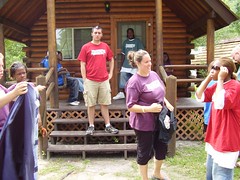
A couple of weekends ago we went to the mountains with two other couples who spend a lot of time together, and while I was excited to go and be with them, my thinking was dominated by worrying if we were the third wheel couple, and so I put on my fearful lenses and saw interactions through those. I was not myself, overthinking all that I said, and eaten up inside. Everything in me told me to just keep it in, to not risk with my friends and admit my junkiness and survive the weekend. But the Lord has given me another gift, the gift of being open and vulnerable (which is not always a fun gift) because I’d rather be known than be alone. And so I shared my heart with the men, and I was so encouraged. Not only did they affirm their love and concern for me and my identity in Christ, but they also shared their own fears of insignificance, and I think our friendship deepened and moved forward that day.

One thing that I began to think about while talking with them and praying was that maybe “favorite” is a term that God would rather us not use. Favorite implies ranking, puts people in classes and orders and elevates them on worthiness to be loved. God would rather us love and appreciate people uniquely, connecting with them on different levels of depth and interest, appreciating them in the moment for who they are and what our relationship is. He also reminded me, again, that my significance is only in Him. Not in people. Not in work. Not in stuff. Sadly, I also realized how long fear of not being the favorite has tainted so many relationships, leading me to be selfish in some, to run from others, to be fearful in still others.

I don’t think that the Father, apart from Jesus, has a favorite in His Kingdom. Except that I am His favorite me. You are His favorite you. Uniquely and wonderfully made, not ranked against other children, not judged or justified on a sliding scale. He simply and consistently loves, who we are, as we are, giving us significance and worth through Christ and the price He paid on the cross.

Sunday, April 01, 2007

An unblievable morning

This Saturday I finally cashed in on my greatest birthday present to date - I went to Lowes Motor Speedway in Charlotte NC and drove a Winston Cup car (I mean NEXTEL CUP)! I can't begin to tell you how much fun I had and what a thrill it was. It wasn't thrilling in the "I was scared for my life" sort of way, but rather just to get a taste of what it was like to go that fast with that much horsepower under you was unreal.After reading this, feel free to check out the video I made of the experience.


The program was with The Richard Petty Driving Experience, and after some instruction I started out with a 3-lap ride-along, driven by one of the Petty instructors. I was able to get in the #8 Budweiser Chevy (just a nice bonus), and the acceleration in that thing was astounding. Going into the turns took your breath away as the g-forces pulled you up the track towards the wall, yet the car just stuck and went on around. I imagine that we went at least 165 miles an hour, and it was as smooth as can be. My legs were weak when I got out of the car, but 3 laps was nowhere near enough.

Soon it was time for my 8 laps driving, by myself (I thought that there was going to be an instructor in the car with me). They make it very easy for you - simply follow the pace car in front of you, staying right in their tracks. They pick the best line around the track, and as you show them that you can keep up, they will speed up. At first I was just amazed to be driving - it seemed surreal, and I had to remember that they wanted me up close to the pace car. As we got going faster and faster, all I could do was grin and yell for joy. It was not very hard to control the car - they are built to go fast and turn left, after all. But it was a thrill to go that fast, that near to being out of control, yet feel like the car would do whatever you want.

The image that sticks in my head the most is being in the middle of turn 3 - you just feel swallowed by the track because the banking is so high - you see pavement above and pavement below. (At the start of the day they took us around the track in a 15-passenger van, and at one point they stopped in the middle of a turn, and you just sort of hung there sideways).

As I got more comfortable, the speeds picked up, and it began to feel like I was really doing it. They had rules about when to get out of the throttle (there were cones on the track for when to give it gas and when to ease up in the turns), and the longer I went, the harder it was to hold off on mashing the gas until getting to the proper cone.The power that those cars have is unreal. In my car, you can be going fast and give it gas and it takes a little while to respond. There is no wait time with these. You hit it, the car GOES! After driving, I was tempted to think, "That's not so hard, what they do each Sunday." Then I remembered that their top speeds are more than 60 miles an hour faster, and they do it with 43 other cars all around them. Not that easy.

I noticed that a lot of the folks there had their friends/family/wives take a ride-along, and so I asked Diane if she wanted to take a ride-along. How often would we have this chance? So, after thinking a moment, she took me up on it, signed up, and soon was off for her own ride. I was glad that she was brave enough to try it, and she had a great time.Jacob was there, too, and unbelievably he slept through most of it! My friend Chris has a great blog post about taking his son to a race, and his contentment in noise is a picture of our opportunity to rest in Christ.

So, thank you to everyone who contributed towards this awesome gift. Special thanks to Diane and to Brian Walker, who organized the gift and who went with me to cheer me on. I hate to say it, but I think I need to do this again someday!

Monday, March 26, 2007

Shooting in the dark

No, this is not a story of crime in my neighborhood. Rather, it describes what I was doing at 8 pm tonight after UNC's loss to Georgetown. I have a tradition of shooting baskets each year after the Heels lose their last game of the season, no matter what time it is. Sometimes I am shooting at 11 at night, others in the afternoon. But most seasons, I end it on a court somewhere. So tonight, after listening to Roy William's postgame interviews, I went to a court in another part of town and shot hoops for a few minutes, making some of the baskets that the Heels just couldn't seem to get to fall this evening.

The first time I did this was in 1984. I was eight years old, and the Tar Heels had just lost to Indiana. There was no reason that this Indiana team should have beaten my Heels that year, what with Michael Jordan and Sam Perkins on the team. I had been allowed to stay up to watch the game, and when it was over, my dad suggested we go shoot some baskets in the driveway. When you're 8 years old and already up way past your bedtime, the chance to play 'ball with your dad at night was a rare treat. So we went out and shot, the floodlight casting long shadows. As far as I can remember, every year since then, that's how my UNC basketball seasons have ended (except for the years when I saw their Final Four losses in person).

I remember getting yelled at by an RA at Carolina in 1995 when the Heels lost to Arkansas in the Final Four because we were shooting on the Avery Dorm court after quiet hours (who was studying at 11:00 pm on a Saturday, especially with football players carousing in the balcony, apparently {and inconceivably} celebrating the loss?). I remember shooting in the dark in 2004, having given up TV for lent and thus relegating myself to trying to not listen to the Heels game against Texas (I dunno, I figured that listening to them was cheating or something), and hearing Rashad McCants' tying three fall short, went straight to dimly lit courts of Lake Daniel Park.

Tonight, more than any other night that I can remember, I was shooting in a fog. The way that Carolina lost, letting a lead slip away bit by maddening bit over the course of 7 minutes, letting a game that we had led pretty much from the start slip away because we could not get the ball in the goal, it just stunned me. I couldn't talk. I wasn't angry. I didn't want to throw anything. It just didn't seem real. Still doesn't.

Now there's 8 long months until the 2007-08 season starts, and I'm uncertain as to which players will still be on the team then. Maybe it's time to change my homepage from Tarheelblue.com to NASCAR.com. I just don't have the heart to do it yet.

Thursday, March 22, 2007

A prayer for Glenwood, and beyond

Was reading in Isaiah this morning, alternating between the TNIV and The Message (yes, I have a parallel Bible with each of these "rogue" translations), and Eugene's translation of Isaiah 32:15-20 really made sense to me in the context of Glenwood and our new Community Garden (see this link for a newspaper article) that we have built (see this link for a news story and accompanying video).

15-20Yes, weep and grieve until the Spirit is poured
down on us from above
And the badlands desert grows crops
and the fertile fields become forests.
Justice will move into the badlands desert.
Right will build a home in the fertile field.
And where there's Right, there'll be Peace
and the progeny of Right: quiet lives and endless trust.
My people will live in a peaceful neighborhood—
in safe houses, in quiet gardens.
The forest of your pride will be clear-cut,
the city showing off your power leveled.
But you will enjoy a blessed life,
planting well-watered fields and gardens,
with your farm animals grazing freely.

Justice will move into the badlands desert
Right will build a home and where there's Right, there will be Peace and what does Right bear? Quiet lives and endless trust.
Are peaceful neighborhoods, safe houses, quiet gardens only for those who can afford them? Of course not. And this garden, I hope, is a part of bringing Right to Glenwood, not to exclude the poor but to bless them, as well as everyone who makes up our community.

In a sermon by Ray Bakke (an urban ministry veteran and "grandfather" in this movement) he recounted a conversation he had with some evangelical leaders in Chicago. They were hearing about his ministry, and one said, "When you talk about sharing the gospel with people in your neighborhood, I get excited, but when you talk about changing systems and things like that, I get uneasy because it sounds like a social gospel." This particular man lived in the suburbs (and there is nothing wrong with that, let me say up front), and Ray asked him why he chose the neighborhood that he did. The man proceeded to list the advantages - safety, good schools, great healthcare options, peace and quiet, and more. To which Ray replied, "All of those reasons that led you to choose your neighborhood are social reasons; you believe in a social gospel as much as I do. Everyone wants those things, but those who have them often say that those who don't should just be content to not have them and that we shouldn't get involved in those social issues." (this is a less-eloquent paraphrase of his story).

As Christians, whether we move in to hard places or not, I think we are called to bear the progeny of Right and work for peaceful neighborhoods and well-watered gardens for all, using whatever gifts and influence that we have on behalf of others, and I have seen many wealthy Christians in Greensboro who don't live in the harder parts of town do just that. I just think that in general it is easier to care about these things when you live on the unpeaceful street, because you are working not just for others but for your own living space.

Interestingly, I feel like my neighborhood association in Glenwood is working for peaceful streets and quiet space, but I fear that this will happen at the expense of the poor. Unless we plan now and make room for Right, for Justice, the peace and quiet will be affordable to fewer people. When others are excluded because they are forgotten and not fought for, that is not God's plan for Shalom, true peace and right-living. I don't think that my neighborhood association is out to get anyone or exclude anyone intentionally - many of them are sympathtic to this issue and sincerely are considering the implications, but displacement is going to happen unless there is intentional and creative planning and leadership.

Wednesday, March 21, 2007

Allow me to be cynical for just a moment


As an IV staff I am guilty of thinking that I am the expert on how Christians should present themselves to culture and interact with culture, and so when something seems somewhat cheesy, I am quick to jump on it and run it down. Sometimes I go overboard. Maybe this is one of those times, but this site, Godtube, just makes me squirm. I know that the intentions behind this site are most likely from a desire for Christians to have safe, "clean" options as alternative to "wordly" things that are admittedly tricky to navigate.

But to me this seems like yet another attempt to remove ourselves from the world, making ourselves insulated and isolated from those who might think differently than us or have conflicting values. It's all the same stuff as regular YouTube, only it's sanitized, Christianized, and mostly irrelevant to people who don't know Jesus. It makes me sad that tons of Christians out there are going to celebrate this site as a positive witness for Jesus on the internet, not realizing that for the most part non-Christians won't darken the virtual door of Godtube, unless it is to mock or shake their heads. Why do we as Christians continue to struggle with relevance, lacking creativity and drive to engage the world with excellence on the world's turf and terms? It's not easy, and it's certainly simpler to spoof and parody in Christian-ese and know that it will be accepted and liked by people who speak the same language. Sigh. Maybe I'm being too hard on this instance.

Tuesday, March 20, 2007

Couldn't be prouder

Now that my two weeks of spring break groups are gone, I can catch up on my blog posts (I have a list of topics in my tasks in outlook).

Each week of spring break we took the Salvation Army disaster van out on a Tuesday night to visit homeless men and women in the city and take them food and drinks. The second week our first stop was right across the street from Greensboro Urban Ministry, and because the weather was warm, the overflow beds were no longer available. Result? There were lots of homeless people hanging out on "the block", and so when our truck rolled up, they all came across the street. Just a few at first, then more and more. And as the first group came, I was across the street from the college students talking with a couple of men that I had met in previous trips out with Nightwatch.

So, there I was, the most experienced in this type of situation, all the way across the street, and a group of 10 college students, who were expecting to talk with maybe one or two homeless people at a time, on the other side with a group of 10 homeless men and women. When I got to them, the students all looked a little stunned, but as I reminded them to simply talk and pray with each person and led them in getting food and drinks out, they recovered and began to really minister. They laughed and talked with our friends, and each person who came was warmly welcomed and prayed with. Students were speaking truth about the Lord and were offering friendship, crossing racial and class and cultural lines, not necessarily with ease but with purpose and love.

While I have grown to realize the truth that the homeless are real people with dignity and real stories to their lives, that has taken time and many relationships and conversations. For most of the students, this was their first time confronting the stereotypes that many of us have, and they did it so well.

Monday, March 05, 2007

All the Pieces Coming Together

Many of you know that we have been running our tutoring program for about 5 years now, and it has continued to grow in size. However, we had size with little to no infrastructure, and so, as a friend of mine put it, it was like this tsuhami of kids crashed into us each week, and then we would recover for a few days and get hit again. There never seemed to be time to get thing under control, and it more felt like survival. That same friend has commented that with tutoring it's like you get two Fridays every week - one on Tuesday when tutoring is over and then the regular one on Friday.

This, however, is changing. God is beginning to move people into place to transform this ministry into one that is effective for the kids and more enjoyable for the tutors. He brought Regina Clark, a businesswoman who specializes in developing an infrastructure to make vision come to pass. He has brought Millie Smith, who has a degree in physical education, and works for a state organization that promotes health and physical activity. Millie now leads an organized play time for our kids and tutors each Monday, which has increased relationships and teamwork amongst them. God brought Jeb Burns, a graduate school education major who is a parent of middle schoolers and who also has a passion for middle schoolers, and he is helpind bring an organized curriculum to that portion of our program. God enabled Melissa Lewkowicz to come on as a paid staff with InterVarsity as an administrative assistant for GUPY and this program. God gave John Freeman, the middle school pastor at our church, a heart for the middle schoolers in our program, and so he serves one day a week. God has brought 7 adult tutors from our church and other churches, which has given maturity and presence to our class rooms. God has given us a tremendous resource in a reading teacher from Guilfor County Schools who is teaching us about discipline and how to help kids read.

Adding these pieces to what we had already has begun to transform our program. Regina has helped us implement a regular schedule each day, which the kids are responding to in a great way. The play time has taught kids and tutors to play together. And there is a calm and an order to our time that there hasn't been. Thus the tsuhami feels more like and regular tide, with some occasional rough seas from time to time (like today when one of the kids stopped up all the sinks in the boys bathroom and turned the water on, resulting in about 1.5 inches of water on the floor and some water in the ceiling below). God is positioning us to have a program next year that is going help the children tremendously.

Sunday, March 04, 2007

Yikes


Diane and I had the privilege of going to the UNC-Duke game and had a great time being together and watching the Heels win. However, I have not experienced mass anger like there was in the Dean Dome after Tyler Hansbrough was bloodied by Gerald Henderson.

There was a moment where I thought things could get ugly, and I wondered if the refs would just get Duke off the court and call it with 14 seconds left. No one threw anything, no one went on the court. But the place was boiling. I felt bad for Henderson - he's just an 18-year-old kid, getting booed off the court and probably being called who knows what. And it was disappointing to feel like the mood at the end was more anger than celebration.

But this has now supplanted the "Bloody Montross Game" of 1992 as the game that UNC fans will remember and point to when thinking of this rivalry.
Incidentally, I have watched about 10 replays of the hit, and while I don't think Henderson was aiming for Tyler's face, he was coming in to commit an aggressive and hard foul after starting the play at the foul-line extended part of the court, and he was bringing his arm down hard, not swatting at the ball and not simply falling into Tyler.

I was disappointed by Coach K's implication that the injury was partly Roy William's fault for having Tyler still in the game with UNC up 11 or 13 and 14 seconds to go. 1) Coach K was calling timeout after his team scored to cut the lead to 13 with 50 seconds left. Certainly not giving up. 2) A sub had been waiting at the table for Tyler when Bobby Frasor was at the line, and Fraso simply missed the foul shot and Tyler got the rebound, setting up his ill-fated free-throw. See this espn.com article for more.
http://sports.espn.go.com/espn/columns/story?columnist=forde_pat&id=2787890&sportCat=ncb

Friday, February 23, 2007

A sad morning in court

This morning my friend Will Dungee and I had to go to court on behalf of one of our friends who was too sick to make his appearance (and we could not get in touch with his lawyer). At one point, Will said, "I wonder what the Lord is preparing us for by having us do things like this for our friend." I don't know the specific reasons yet, but it was an eye opening look into one part of our justice system.

The Assistant DA who was running the courtroom I had to go to (our friend's charges were being dealt with in two separate court rooms at the same time - how does that work?) made no effort to be pleasant. It was simple traffic court, but she made no ability to speak with kindness. It was clear that she wanted to establish that she was in charge and her rules were the only ones that counted. I understand a need for order, but her rules became laws that were immovable. For example, she misread the name of one woman sitting next to me, and so the woman didn't catch it. Realizing that the DA might have said her name but mispronounced it, she asked her if she could pause and repeat it (the DA was two names down the list by then). The DA said she could not and would not, and that the woman would have to wait. She did not say it kindly, and she seemed to enjoy being in charge. Thankfully, a lawyer later helped this woman, finding her case in the pile and giving it to the DA.

No questions were permitted, and people were treated like an annoyance. Will and I received the same treatment upstairs in the DA's office, as we had gone up to see if we could get the case continued without sitting through the docket. Another Assistant DA came out to see us and said, "Who are you?" in a way that made me feel like I was very small. When we explained our situation he told us just to go to the courtroom and listen for Kevin's name, and when we asked what we were to do then, he began walking away and said, "Just go down there." Will was in his courtroom, and said that he was extremely rude, telling people to shut up and asking who gave them permission to speak.

The thing about going to court is that it's not very intuitive for most defendants because they/we don't spend a lot of time in that place and culture, and if you don't know what you are doing, it's hard to play the game. I see why so many people hire lawyers because it's tricky and time-consuming for an average person to navigate the legal system. And unfortnuately, the rules of the courtroom game don't permit you to ask questions without being treated like an annoyance. Sure, the DA lays down some ground rules before calling the calendar (say either "guilty", "not guilty", "continuance", or "attorney" when you hear your name called), but what happens after that is for them to know and you to find out. For example, I said "Continuance" when my friend's name was called, and then they took out the stack of continuances and began to read the names and assign another court date. But there was a small stack of "continuances" whose names were not called, and were just left there. My assumption is that my friend has overextended his continuance graces, but that was never explained or addressed or mentioned, and I dared not ask.

The ADA also treated the room like a group of 5-year-olds, telling people to sit down rather than stand in the back, which is fine, because those are the court rules, but her tone and demeanor was that of a teacher talking to a group of Kindergardeners who had never been to class before. What I sensed from her was fear and control - she drew these really fine and tight lines and there were no exceptions because unless the laws/rules were kept to the letter, who knows what might happen? (sarcasm) People who had the audacity to challenge those by asking a question or not getting them right the first time were shamed. I also felt that she enjoyed being charge, but hated her job and disliked all the people there who were overloading her docket and were probably up to no good anyway (note: she did not say any of this - this is my perception).

Looking around the room, the defendants were 98% black and Hispanic. The people in charge up front were 99% white (I saw one black attorney) and mostly male (the ADA in my court room was a woman and there was one other woman lawyer). The power dynamic was clear - there was a way of talking, a way of operating, and if you didn't know how to talk and operate in that way, you were in trouble. At first I thought of this as a racial divide, but really it was a class divide. Now, race and class are not easily separated here in Greensboro - the have's tend to be white and the have not's tend to be black and Hispanic - but Will helped me clarify that this was primarily a class gap. The ADA was communicating in a way that was not familiar or effective to the class/culture mostly represented in the courtroom, and the defendents' way of communication was not acceptable to her, for the most part.

It made me sad that our legal system has created a dependance on lawyers not to defend
us but to play the game for us because it's too hard to play for ourselves, and to see that the racial makeup of those on trial was overwhelmingly black and Hispanic showed that our society is still slanted along lines of race, class, and power.

Wednesday, February 21, 2007

From the mouths of babes 2


If you are a parent of young kids, you will appreciate this. The other night, Eliza asked, "Mommy, does Jesus skidoo into our hearts?"

It's something like that.

Tuesday, February 20, 2007

James 1:5-8 - Belief, Doubt, and Prayer

My good friend Alex is studying some in James, and he left a comment recently about James 1:5-8, which says, "If any of you lacks wisdom, he should ask God, who gives generously to all without finding fault, and it will be given to him. But when he asks, he must believe and not doubt, because he who doubts is like a wave of the sea, blown and tossed by the wind. That man should not he think will receive anything from the Lord; he is a double-minded man, unstable in all he does."

Alex wrote: what did you/your small group do with chapter 1 with the part where God gives genrously to all without finding fault UNLESS you're a doubter, in which case you shouldn't expect to receive anything at all. It seems that's a pretty significant blockage...and I'm having a hard time finding a way around it.

This is indeed a troubling passage when taken at face value. It seems that it's all up to us - God will give generously, but with a condition. But, as Alex knows, we have to use the full counsel of Scripture to interpret passages that are confusing or don't seem to jive with the God we know, and so that is where I started in thinking about this. If this verse were true at face value, then the man whose son was possessed by a demon in Mark 9 was in trouble, because his "prayer request" for healing was followed by, "I believe; help me overcome my unbelief. "Sounds like there is doubt there to me. Yet Jesus healed him, generously.
The NIV Bible Commentary says this, "This father was not oscillating between belief and unbelief. He desired to believe--and even asserted his belief--but because he felt keenly the inadequacy of his faith, he asked for help in believing. He was not facing both directions at the same time like the "double-minded man" of Jas 1:8. In spite of his conscious weakness, he had set his heart to believe. And Christ responded to his faith and healed his son."
There is also the passage where Jesus tells us that if we have a mustard seed faith, we can move mountains, which once led me to despair. If all it took was a mustard seed to move a mountain, I must have incredibly little faith, because I had not moved any mountains. But perhaps Jesus' words were less a commentary on the required amount of faith, but rather on the powerfulness of the faith's object - that God is so mighty that He takes the mustard seed that you give and moves the mountain.

We also have to let verse 5 inform 6 and 7 - God's gives generously without finding fault. We as Christians are in Christ, and we have sonship relationship with the Father. He loves and longs to be generous to us, which Eugene Peterson shows well in his Message translation of these verses:
If you don't know what you're doing, pray to the Father. He loves to help. You'll get his help, and won't be condescended to when you ask for it. Ask boldly, believingly, without a second thought. People who "worry their prayers" are like wind-whipped waves. Don't think you're going to get anything from the Master that way, adrift at sea, keeping all your options open.

My friend Macon came up with this a helpful analogy (or he borrowed it from our favorite theology professor, Gary Deddo) to talk about the role of faith in prayer. Macon asks the question, "How much is enough to get my prayer answered?" So, does God require that I be 100% certain? How about 98%? Or is it just a majority, like 51% sure that tips the scales on my behalf? If I have 49% or less, am I unable to get God to move? Knowing my own heart, there have been few, if any, times that I have had 100% faith when I prayed. On my BEST prayers I've been in 90% range, I think. Yet God has answered. God has moved, using the the faith that I offered. See, Jesus lives in me and He lives for me. I no longer live, but Christ lives in me. I no longer pray, but Christ prays in me. And so I offer Jesus my 30% faith and He takes that prayer, perfects it, and offers it to the Father on my behalf as a 100% prayer.

It seems that Scripture is full of doubters and strugglers, men and women who did not have 100% faith, and yet God still moved for and in them. Think about Gideon's fleece, John the Baptist's father, Sarah's laughter. It seems that God is not limited by our faith, or lack thereof, in the way that we think He might be. Yes, faith is important. But God can work with far less than we offer, and He answers feeble prayers just as much as He answers confident ones. Prayer being answered is not about our rubbing the magic lamp just right so that the genie comes out and gives us our wish. It is a recognition of need that we cannot supply, and whether we are 100% certain that God will come through and meet that need as we see fit, we still recognize that we need help and are asking with all the faith that we can muster.

So, all of this gives me a new lens through which I have to read James 1:5-8. One key phrase in this passage that the NIV Bible Commentary points out is, "he is unstable in all he does." The double-minded man is not someone who prays to God and has some doubt that He will answer, or someone who has imperfect faith. Rather all that the double-minded person does is characterized by flip-flopping and indecisiveness in their relationships, their work, their walk with the Lord.

In sum, I think that when I operate as a person under the Law, James is very troubling. The Law view of prayer would say that there is a standard that I have to meet in order to unlock the power of God. But Jesus has met that standard for me, and lives that standard in and through me now that I am in Christ. I am not a double-minded man, because I am in Christ and I have the mind of Christ (Col. 2:16). I am not abandoned to my weak faith, but can in all things depend on Christ, crying, "I believe, Lord help my unbelief."

What do you think?

Sunday, February 18, 2007

Overwhelmed for dependence's sake

It's been a hard few weeks since Jacob arrived; of course there is the normal lack of sleep and adjustments to a new child. Then last week Diane was in the hospital for 36 hours receiving a magnesium IV to lower her blood pressure (induced by pregnancy), which meant a couple days of scrambling to get childcare and make sure Eliza and Palter were OK, a night spent sleeping on a couch in the hospital room (watching UNC loseto Va Tech) and another night at home getting up with Jacob to give him his bottle. Needless to say my resources are depleted, to say nothing of my poor wife's energy and resolve, given Jacob's every-two-hours feeding schedule and her time in the hospital.

So today I was reading in 2 Corinthians 1:8-9 which says, "We do not want you to be uninformed, brothers, about the hardships we suffered in the province of Asia. We were under great pressure, far beyond our ability to endure, so that we despaired even of life. Indeed, in our hearts we felt the sentence of death. But this happened that we might not rely on ourselves but on God, who raises the dead."

There is a rumor that makes its rounds in Christian circles that says God won't put more on a person than they can handle. If that was true, then what happened to Paul? He was under pressure greater than his ability to endure, clearly more than he could handle, and he said that God let that happen in order to create dependence, not relying on himself but on God. (This thinking is actually a mis-application of 1 Corninthians 10:13. which says, "No temptation has seized you except what is common to man. And God is faithful; he will not let you be tempted beyond what you can bear. But when you are tempted, he will also provide a way out so that you can stand up under it.")

It seems to me that God constantly gives me more than I can handle. Life is more than I can handle - it was too much when I had no kids, when I had one, when I had two. This week I feel like I am at the end of my patience. I feel like crying sometimes for no reason. I feel distant from my wife as each of us is preoccupied with caring for the little ones. All this is happening that I might not rely on myself, but on God, and until today I was trying everything but, from buying and selling cell phones on ebay, to checking email, to angrily throwing a bowl full of cereal and milk into the sink and storming off the bedroom when Eliza informed me that she didn't want milk on her Cheerios.

If I could handle life, I would not need God at all. I believe that God's ultimate purpose for all people is for us to depend on Him for all things. And so He often gives me more than I can endure, taking me to the limits of my patience, ability to love, time, and energy so that I have to say, Lord, I give up. I need you to live through me. Reconnecting with Him through Scripture and worship has reminded me that relying on Him is life, the only life and hope that I have.

Tuesday, February 13, 2007

James Thoughts, Part Three

Context, Context, Context
James 4:2b says, “You do not have because you do not ask God.” This has been pirated by "name it and claim it" folks who use the verse to put the fault/potential on the Believer to get God to do what we want Him to do. You simply must ask, with faith. If you don’t have insert thing here, it’s because you are not asking. But the context for this verse is so important, because the issue that James is addressing is not faith (or lack thereof) but dependence on God. People are trying to meet their own needs by fighting and quarreling, coveting and killing. They don’t have because they are trying to supply their own needs rather than asking God, depending on Him to supply their needs. Their motives of independence and self are revealed in verse 3, when they are called out for spending their blessings on themselves.

Smackdown… Or Is It?
So in 4:4-5, it seems that James is finally letting them have it – now they can feel nice and guilty for being such rotten Christians. Calls them adulterous people who are making the Spirit of God jealous. Go ahead James, land the knockout blow! But then, in verse 6 it says, “But He gives us more grace.” They’ve blown it, raised God’s ire – adulterous people for crying out loud. This is true for all of us. BUT He gives us more grace. If you operate in independence (pride), God opposes you. But if you are dependent (humble), He gives you more grace. Humility and dependence begets grace.

Monday, February 05, 2007

Jacob Pictures


Here are a couple of links: first Jacob's birth , then Jacob's first week. Enjoy!

P.S. In this photo he's thinking, "Did State reallybeat Carolina? The Heels needed more intensity."

Sunday, February 04, 2007

From the mouths of babes

Eliza really enjoys pretending and making up stories with her Belle and Arielle dolls, and the last couple days she has been pretending that they were in heaven talking to Jesus, and that He invited them to stay for a sleep over. Today I overheard her saying, "Well, Jesus died on the cross for your sins," followed by, "OK, God, if you say so - I trust you." It's just that simple, folks. How sweet.

Saturday, February 03, 2007

James Thoughts Continued

Mercy Triumphs Over Judgment

James 2:12-13 says 12 Speak and act as those who are going to be judged by the law that gives freedom, 13 because judgment without mercy will be shown to anyone who has not been merciful. Mercy triumphs over judgment!

I think that it is easy to read this and see only, “Speak and act as those who are going to be judged,” but what are we being judged by? By the law that gives freedom. James is showing a new or different standard; there is a judgment without mercy (v. 13), but we are going to be judged by a law that gives freedom. Mercy triumphs over judgment. Love triumphs over evil.

We are to speak and act as people who are judged under mercy and freedom. We give away what we have received from the Lord, and we trust that the way of mercy is the best way. Judgment without mercy is given to those who do not show mercy, but we have been judged with mercy.

Mercy Leads Us to “Do”

James 2:22-23 is a call to be do-ers of the Word, not just hear-ers. A worthy call. I think that we as Christians should be authentic, living what we say we believe (I believe that Steven Curtis Chapman said it best with, “It’s got to be true, I gotta’ be living’ what I say I believe, even if nobody but Jesus is watchin’ me. G-O-T T-O-B T-R-U.”). However, there is a lens of law and a lens of grace. Law says, “Do it because I said so, and if you don’t you don’t measure up.” On first glance, that is what James is saying. But grace says, “I have given you all you need to ‘do’; I have loved you first; therefore ‘do’.”

James 2:25 gives that grace motivation. If you look intently into the perfect law that gives freedom (there's that concept again!), and continues to do this, he will be blessed in what he does. There is a correct order – look into the law that gives freedom, and then be a do-er of the Word. If you “do” from the position of freedom, there is blessing.

I wonder if James, who addresses his letter to the 12 tribes scatterd, is writing to a Jewish-Christian audience, and so he uses the law a lot, knowing their tendency to depend on the law for right-standing with God. Could it be that he is revealing the inability of the law to bring righteousness, calling them to depend on mercy and grace.

Coming up next: Context, Context, Context! and Smackdown... Or is It?

Thursday, February 01, 2007

New Eyes For the Book of James

James is About Grace!
When I was in college, I read the book of James. I knew very little about grace (i.e. I had not experienced grace on deep levels), and so when I read it, I felt very guilty, as though I were not doing enough. After all, there were lots of admonitions in there about doing things, showing faith by works, being nice to the poor, not saying bad things and controlling the tongue. The book made me feel like I was REALLY not measuring up, and I had done a pretty good job of that myself as it was.

Recently James popped up in my Bible reading schedule that my small group and I are going through, and I remembered how much I had avoided James (except for the times when I referenced the passages about the treating the poor well). I also had been struggling (again) with feeling helpless to help the homeless in Greensboro and knew what James had to say about loving the poor, so I asked God to help me read this and receive conviction when He had it in mind without guilt. And what I discovered is that James is a book about grace, mercy, love, dependence on God and humility. Who knew? Sooo, I am going to try and download some of what I found in there. I have not checked this against a commentary (Eugene Peterson would be scolding me from the pages of Eat This Book – I promise, Mr. Peterson, I am taking in what you are telling me), so there is a chance that I could be off, but just figured I would put it out there and my legions of blog-reading fans could correct me when they want to. I don’t usually use this blog to post teaching stuff, leaving that to my esteemed colleague Alex Kirk and his blog “Piebald Life.” But what the heck!
Note: OK, at the end of this I did check a commentary, and got some good stuff from it!

Laws That Give Freedom?
So, the first verses that really jumped out to me were 1:25 and 2:12; each of them referred to a law that gives freedom, which has never seemed like a concept that makes sense. Laws don’t give freedom (I thought) – they bring bondage (when you break them); they restrict (when you keep them), and even when you keep them you can fall into the temptation of pride in how well you keep the law on your own.

As James spoke of a law that gives freedom, he was already shaking my understanding of what he is teaching of us. This perfect law that gives freedom is the law of love. It is not an enslaving legalistic system, but a law that gives freedom and the Believer is enabled to keep it by the empowerment of the Holy Spirit (Galatians 5:22-23). Here is further info on this (all commentary comments are from the NIV Bible Commentary) - James's term "the perfect law of liberty" (literal translation) deserves special attention. The word "law" (GK G3795) reveals his Jewish orientation and that of his readers. But he qualifies this word to make sure that his readers do not misunderstand, describing it as "perfect" (GK G5455) and as characterized by "freedom" (GK G1800). It is not merely the OT law, nor is it the Mosaic law perverted to become a legalistic system for earning salvation by good works. When James calls it the "perfect law," he has in mind the sum total of God's revealed truth--not merely the preliminary portion found in the OT, but also the final revelation made through Christ and his apostles that was soon to be inscripturated in the NT. Thus it is complete, in contrast to that which is preliminary and preparatory. Furthermore, it is a law that does not enslave. Instead, it is freely accepted and fulfilled with glad devotion under the enablement of the Spirit of God (Gal 5:22-23; see Jas 2:8, 12 for more on this concept of law).

So, this may not be groundbreaking to many of you. But for me, to find that there is a law that gives freedom, a law of love, and to know that God gives us the love that He asks us to extend to others, is good news. More to come on God’s grace leading the way.

Coming next: Mercy Triumphs Over Judgment and Leads Us to “Do”

Sunday, January 28, 2007

Jacob Marshall Benbow is here!

What a wonderful day it was yesterday, as Diane delivered Jacob at 6:42 pm. He has brown hair, giving us a brunette, a blonde, and a red-head, and he is very laid back and sweet. In fact, he is so laid back that Diane is having trouble getting him to wake up and eat! Check the video below for Eliza and Psalter's first meeting with Jacob. Will post some photos on Flickr as soon as I figure out how to make a new grouping on the site.


Friday, January 26, 2007

First video for Jacob, who is arriving tomorrow

Still more technology from flickr

Here is a GUPY 2006 photo. Click it and this will link you to more pictures on flickr.

Glenwood Camp From Dayna 324