Monday, February 05, 2007
Jacob Pictures
Sunday, February 04, 2007
From the mouths of babes
Saturday, February 03, 2007
James Thoughts Continued
Mercy Triumphs Over Judgment
James 2:12-13 says 12 Speak and act as those who are going to be judged by the law that gives freedom, 13 because judgment without mercy will be shown to anyone who has not been merciful. Mercy triumphs over judgment!
James 2:22-23 is a call to be do-ers of the Word, not just hear-ers. A worthy call. I think that we as Christians should be authentic, living what we say we believe (I believe that Steven Curtis Chapman said it best with, “It’s got to be true, I gotta’ be living’ what I say I believe, even if nobody but Jesus is watchin’ me. G-O-T T-O-B T-R-U.”). However, there is a lens of law and a lens of grace. Law says, “Do it because I said so, and if you don’t you don’t measure up.” On first glance, that is what James is saying. But grace says, “I have given you all you need to ‘do’; I have loved you first; therefore ‘do’.”
James 2:25 gives that grace motivation. If you look intently into the perfect law that gives freedom (there's that concept again!), and continues to do this, he will be blessed in what he does. There is a correct order – look into the law that gives freedom, and then be a do-er of the Word. If you “do” from the position of freedom, there is blessing.
Coming up next: Context, Context, Context! and Smackdown... Or is It?
Thursday, February 01, 2007
New Eyes For the Book of James
James is About Grace!
Note: OK, at the end of this I did check a commentary, and got some good stuff from it!
So, the first verses that really jumped out to me were 1:25 and 2:12; each of them referred to a law that gives freedom, which has never seemed like a concept that makes sense. Laws don’t give freedom (I thought) – they bring bondage (when you break them); they restrict (when you keep them), and even when you keep them you can fall into the temptation of pride in how well you keep the law on your own.
Sunday, January 28, 2007
Jacob Marshall Benbow is here!
What a wonderful day it was yesterday, as Diane delivered Jacob at 6:42 pm. He has brown hair, giving us a brunette, a blonde, and a red-head, and he is very laid back and sweet. In fact, he is so laid back that Diane is having trouble getting him to wake up and eat! Check the video below for Eliza and Psalter's first meeting with Jacob. Will post some photos on Flickr as soon as I figure out how to make a new grouping on the site.Friday, January 26, 2007
Sunday, January 14, 2007
A book that lives up to its name
As I was reading Practical Justice: Living Off-center in a Self-centered World by Kevin Blue, I had the thought, "Man, these chapters are so practical." Then I remembered that the book was living up to its title, and really appreciated the skill and intent of the author. In yet another super book from IV press, Blue (who is a colleague of mine in InterVarsity Urban Project circles) clearly, prophetically, and theologically exhorts Christians to see the Bible with eyes of justice, and to live out the teachings and call of Jesus. The thing that makes this book such a great resource is that Blue doesn't just talk theory, but rather gives simple and practical next steps, some of which are very challenging and some of which are accessible to anyone. For example, in his chapter "Giving a Man a Fish" which teaches on meeting immediate needs of the poor and homeless, Blue gives four pratcitcal steps. 1) Buy a homeless person food and sit and eat with them and offer to pray with them about their circumstances. 2) Volunteer at food pantry or serve at a homeless shelter. 3) Visit a convalescent home that houses residents who are economically struggling. 4) If you live in a less-urban area, identify the pockets of poverty that certainly exist and ask God how you might be used there.Blue also made me squirm with conviction a couple of times. In particular his chapter "Should I Help?" adddressed some of the excuses that I often make in not helping people. Here are the paragraphs that messed with me.
"Give a man a fish and he'll eat for a day. Teach him how to fish and he'll eat for a lifetime. Therefore don't give him a fish." This is the cultural mantra of much of the middle and upper class. While Jesus says directly to give to those who ask (Matthew 5:42), we are encouraged to interview, be suspicious of, and ultimately not give to beggars. Why? It seems that we think people are poor because they ought to be. Or is it a disease that can be caught if you associate too closely? We are taught that those who are poor don't want to work, are manipulative, don't care about themselves or others, are criminally dangerous, or are unmotivated to do better. Yet Jesus doesn't mention any of these conditions as a reason not to give to someone in need.
Now, Blue has more to say in this chapter, and he is balanced and grace-filled as he speaks truth. But he calls Christians to embrace God's heart of justice and show us ways that we can participate in that, and he writes to exhort, encourage, and challenge. I highly recommend this book.
Thursday, January 11, 2007
If I were really, really rich for just one day...

I would buy one of these in heartbeat.
And give lots of money to starving kids all over the world.
I would most likely be donating said money via previously coveted -I mean mentioned - iPhone, which has internet capability. So I would donate money while listening to songs (or watching a video) and fielding a phone call, but not while I was driving.
Monday, January 08, 2007
My kind of church
In the room were single moms and singles without kids. Young married couples with babies, and older marrieds whose kids were in college. There were poor and moderately wealthy, black and white, struggling and established, many walking with Jesus and some teetering on the brink of falling away. I watched Eliza and Psalter playing with some of the kids who come to tutoring and felt the ease with which everyone in the room interacted and loved each other, not dwelling on racial and class lines. The community love there was genuine, not a forced attempt at reconciliation or a sense of the haves giving to the have nots. And I couldn't help but think, "Now this is church."
That is not to say that my worship experience earlier that day was invalid or not spiritual. I was fed from God's Word, I worshipped with Brothers and Sisters in Christ. But as I continue to read Scripture with the lens of reconciliation and transformative justice in place, I can't help but believe that church is should be more than homogeneous, more than based on worship preference, more than good sermons. It should be a place where the boundaries of our culture and prejudices are overcome by love and good deeds, by a commitment to relationship for the long hall, and by a commitment to gathering people of varying background, cultures, and financial means.
And that gathering of a diverse people should be a more concentrated gathering than what I typically experience. There certainly are people of several races and cultures who worship regularly at my church. There certainly are people of varying economic levels in service on Sunday. But they are scattered, not concentrated, and are therefore often overlooked and unheard, and their transformative presence is not felt by the Body at large.
I am both sad and thankful for the gift of our time yesterday. Thankful because it was sweet to my spirit and gave me a hopeful picture of a beautiful church. But sad because most of our friends from Glenwood who were at this party do not attend our church on Sundays, and I wonder how long it will be until yesterday's snapshot becomes a living reality.
Wednesday, January 03, 2007
Getting Reconciliation Blues

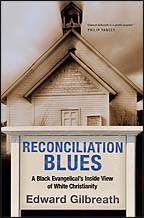
I can count on two fingers the number of books that I have read on one day – The Hobbit and, now, Reconciliation Blues by Edward Gilbreath. Granted, I read this book over the course of a day of traveling from St. Louis to NC, but the day wasn’t that long, and the book kept my attention.
I think that this is a new must-read for the Church, both for those of us who already are on board the racial reconciliation movement, and for those who are not sure or have not even begun to think about it. What I think this book does very well is that it presents the racial divide in the American Church in a way that is palatable and readable. In a review quote on the cover, Phillip Yancey calls Gilbreath a “gentle prophet”, and that description is right on. Because Gilbreath is a black man who has lived, worked, and worshipped in a largely white evangelical context, and who identifies himself with the evangelical label, he can speak with experiential authority of the struggles of minorities in the evangelical world. But rather than cast stones and bitterness, he presents his experiences in a truthful and gentle way.
Another strength of this book is its breadth. He does not get bogged down in statistics, nor does he spend a lot of time on one particular area, but instead he covers a broad swath of the evangelical world, from worship (an EXCELLENT chapter) to politics, and he also has some insightful chapters on black evangelical leaders like Martin Luther King, Tom Skinner (click to check out this talk from Tom at Urbana 70, but I would listen to it sitting down because it is amazing and jarring), and Jesse Jackson, and talks about why some/many in the evangelical world hesitate to identify Jackson, and even King, as evangelicals.
Gilbreath is a journalist and an excellent communicator, and I have found his book a terrific blend of facts and experience. While Divided By Faith is an profound and prophetic look into the state of race in the Church, readers can easily get bogged down in the numbers and sociological language, especially if they are just starting down the road of racial reconciliation. This book is easy on the eyes and challenges the heart and mind, but does not leave you feeling condemned or hopeless.
An excerpt from his chapter called The First Shall Be Last:
“Pursuing diversity is not just for the benefit of minority groups; we all stand to gain from it. But without a sustained, intentional effort to make changes, it’s easy for evangelical institutions to fall right back into their “white” default mode.
"I don’t mean to sound jaded or cynical. I understand that a big reason for this lack of a sustained intentional effort is the natural human tendency to gravitate toward that with which we’re most comfortable. But I’m also guessing that much of it has to with appeasing donors and constituencies. Money and economic control go to the systemic root of a lot of our race problems in the evangelical church – but I don’t want to dwell there. Suffice it to say, it’s risky for a nonprofit to upset its funding base. Whether it’s a matter of donors, subscribers or even chuch members, it’s a lot easier – and cheaper – to keep an existing patron than to find a new one. When Jesus said, “You cannot serve both God and Money (Matthew 6:24), he was foreshadowing one of the fundamental complications of running a Christian organization today. Ask any pastor or ministry leader – it’s a crazy balancing act. Yet it speaks to the heart of where our priorities are, and who we are as the people of God.”
Saturday, December 02, 2006
Loving Your Enemies on the Street Corner
When she got home she was angry and hurt and frustrated. We feel like we are one of the “good guys” when it comes to the poor, and here Diane was getting blasted by this woman for no reason. She was also upset at herself for getting so angry with the woman. I was fairly angry, too, but then, as only God can do, the chapter of Luke that I read today came to mind. In Luke 6, Jesus tells the crowds that if they love people who love them, what does that say? Even sinners know how to love people who love them back. But followers of Christ are to love their enemies. To bless when we are cursed, to do good to those who don’t do good to us. And so instead of offering to go and give the lady a piece of my mind, I offered to go and take the her some food.
But my sweet wife wouldn’t have that. Instead, she collected herself, then collected a big bag of food, and went back out to find this woman. When she found her, she got out and apologized for her attitude, and they actually hugged, and the woman apologized for how she treated Diane. Diane told her, “I know you weren’t angry at me.” And the woman said, “You’re right; I wasn’t. I’m just angry.” Diane noticed that the woman’s hand was bleeding (she had scraped it in a fall), and so she came back to the house and got her some band aids and wet wipes and Neosporin, and went back out again.
Amazing that God gives us chances to see His word prove true in action, giving us chances to let Him live through us. I could not figure out why the verses about loving our enemies stood out to me this morning – I don’t really have any enemies, and I wasn’t sure how to apply it. Then the Lord gives my wife the chance to live that out in a powerful way. How cool is that?
Thursday, November 30, 2006
Is Homelessness Wrong?
I don’t think it is a sin to be homeless, with sin being my definition of “wrong”. I do think that sin usually causes and sustains homelessness, whether that sin is personal, societal, familial, or a combination of those and more. People can end up on the streets because of their addictions (this is personal sin, which is often a response to numb the pain from familial or societal sin). People can end up on the streets because of mental disability (mental illness is a result of the Fall and also a societal sin of not caring well for the sick). People can end up on the streets because they lost their job or had a financial emergency and do not have the same financial safety net that I might have through family and friends (this is a result of societal sin, where wealth is predominantly concentrated among the few). People can end up on the streets because they just don’t want any rules in their life (which I think is a sign of rebellion in their spirit, which leads to rebellion against God’s authority, which is the root of sin). Children can be homeless because their parents have one of the above conditions (this is a combo of all of those above). Teens can be homeless because they are running from family or life (this is a result of their sin, familial sin, and more).
However, I have not met a homeless adult who said, “You know, the whole living in a house thing just wasn’t for me. So one day I decided to just give it all up and become homeless, because it seemed like a good idea.” (Homeless teens have sometimes given me that response, though I am not 100% certain that they believe that themselves). Certainly there are homeless now who remain in that position by choice – there are no rules, ultimate freedom (if freedom is defined as “being able to do what you want to do when you want to do it”, which I think is a poor definition of freedom). They may remain homeless by choice because they have given up hoping for anything else. They may remain homeless by choice because they are not yet sick and tired of being sick and tired. They have carved out a life for themselves on the street, and they like it that way.
Societally we do have a mentality that people should work for what they get, and we tend to not see panhandling as work, and so when we see someone with a “homeless, please help” sign on the side of the road, we tend to think that this is wrong. I don’t think that it is wrong in the sense of sinful, but is it God’s ultimate hope and plan? I just don’t know about that. It seems that we have been created with more dignity than what I see written on the faces of the homeless panhandlers – there is shame there, there is a feeling of not being productive, there is a feeling of being judged and looked down on, and work is a part of living out that dignity. Work is a good thing, given by God as part of what we do as humans.
Of course not all homeless panhandle. Some have jobs that just don’t pay living wage (societal sin); some scrape enough money to get by collecting cans and recycling them and provide just what they need. Homelessness has many more faces than I once thought, and it’s not just the people under bridges. It’s also the family that I know who has not lived in their own place in four years, and they have lived in at least 7 different places in the last two.
So is homelessness wrong? Yes. I think that it is wrong that there are people sleeping under bridged and in cars. I think that it is wrong that there is a homeless veteran in a motorized wheelchair who lives behind a gas station here. Homelessness is a sign of the brokenness of our world, of the lack of shalom (God’s peace and right living) all over our cities. A person is not in sin because they are homeless, but they are often homeless as the result of sin and brokenness, both in their own heart and life and from the sin and brokenness heaped on them by others.
I could be wrong. I’m not expert. Those are simply my two cents.
Saturday, November 18, 2006
They're Still Out There
As I woke up at 10:00 this morning and went to take a nice hot shower, I thought, “They’re still out there.”
As I watched UNC beat State in football, I thought, “They’re still out there.”
They’re still out there – each of the men that we prayed with and gave food to are still sleeping outside on the street. One was sleeping in the front doorway of my church – we had spoken with him at about 8:30 pm, and saw him sleeping, somehow, on the concrete at 2:00 am in the cold night. There were men sleeping on pipes suspended beneath the bridges, men sleeping in abandoned trailers, men in church doorways, men on foam mattresses beneath highways, men in a shed behind a local business.
Sure, it’s nice that we gave them a warm hat and blanket and prayed with them. It’s nice that 5 Christians gave up their Friday night to do some good deeds. But for the rest of that night, and the rest of that week, those guys are still out there. And I don’t know what to do with that.
Thursday, November 16, 2006
Bearing Fruit
As I prayed through verse 10, it struck me that Paul does not say "bearing the fruit of every good work." Isn't that how we usually view service to the Lord - fruit equals what I do and my works? "A tree is known by its fruit," we say, "and the fruit for a Christian is what we do."
But Paul tells us that in the midst of doing good works (which God has created us to do and prepared for us in advance, according to Ephesians 2:10), we are to baer fruit. And this gets down to the issue of the heart - when I am serving someone, am I bearing love and kindness, or am I bearing self-righteousness and duty. When I am taking time from my everyday life and want to focus on God's Kingdom and love people in hard places, am I bearing the fruit of joy or the fruit of joyless service?
GAL 5:22 But the fruit of the Spirit is love, joy, peace, patience, kindness, goodness, faithfulness, 23 gentleness and self-control. Against such things there is no law.
These are the things to bear in the midst of good works. It is so easy as Christians to think that the works are the most important thing, no matter the attitude or heart. Discipline, sacrifice, cross-bearing are important concepts in many evangelical circles. And yet Paul tells us in 1 Corinthians 13 that to do works without bearing the fruit of love makes us a gong or a cymbal, makes our works impotent. To divorce the concepts of sacrifice and discipline from the fruit of the Spirit (rather than having those empowered and enabled by the Spirit) is to regress into being people under law, not the freedom of Christ.
May we, you and I, be a people who do not grow weary in doing good, and as we do good, may we bear the fruit of the Spirit, that God might be glorified and seen, not our works themselves.
Monday, October 30, 2006
All I have to offer
Today I was stopped by one of our tutoring parents whose daughter started attending a few weeks ago. She asked me if our church provided financial assistance because she and her two girls were about to be evicted. As we talked, I learned that the father of her kids is supposed to give $650 a month in child support, but he has gone into hiding. So she is making due by working 37 hours every two weeks at $6.25 an hour, or $462 a month before taxes . Simple math tells us that, with her rent being $600 per month, she is not making ends meet, and even with child support, her monthly income would be almost 1/3 of what I make.
I was grieved when I came home, knowing that in about 24 hours or so, my month’s salary would “magically” appear in my bank account via direct deposit, and all my bills would be paid for, and soon our “new” minivan would be paid off (yes, I have now entered the Minivan Stage of life). While I didn’t feel guilty for what Diane and I have, the stark contrast between my life, and the life of this family really hit me. Her daughter who attends our program is such a sweet kid, and to think of the transitions that she has endured even in recent months (living in a hotel for four months before moving to this house) makes me cry. How can a child go through that and not shut down their heart? How can a parent who is facing such obstacles greet me at the door with a smile on her face?
I had to tell her that our church can’t help them right now and pointed her to the Greensboro Housing Coalition, and then we prayed on her front porch. It was all I had to offer, and, correct theology aside, I felt that it wasn’t enough. And yet I am thankful to be here, because prayer is what she needs. More than a check. More than a new house. She needs to be reminded that there is a God who cares, who loves her dearly, and who will take care of her and her family. It truly was all I had to offer, and it was all that she needed.
Tuesday, October 10, 2006
50
Sunday, October 08, 2006
Eliza-isms
Tuesday, October 03, 2006
Relearning the secret
This is no surprise given the fact that I had spent very little time with the Lord in that stretch, and had begun to depend on myself and my abilities to make life work (which is no surprise, since if I am not dependent on the Lord, where else can I turn but to myself). I was churning inside, overwhelmed and tired from trying to keep everything together. Thankfully, the Holy Spirit broke through, reminded me of what I needed, and led me to set the alarm to get up early yesterday morning to spend time with my Father. As I poured out my discontent into my journal and read Ephesians 5, the contrast between the truth of God and the lies I was believing became more and more stark. For example, when I believe that it is up to us to save a certain amount of money and scheme to buy the most amazing $6000 car ever, I am not living in the Truth that God, my Father, is my provider. I don't have to provide for myself, nor can I. I am God's son, a child of light, no longer darkness, no longer and orphan or His enemy. I am a dearly loved child of God. Will my God not provide for me in love?
Phillipians 4:13 is a widely-quoted, much loved verse which says, "I can do all things through Christ who gives me strength." But it was only a few years ago that I realized that this verse came in the context of Pauls saying, "11I am not saying this because I am in need, for I have learned to be content whatever the circumstances. 12I know what it is to be in need, and I know what it is to have plenty. I have learned the secret of being content in any and every situation, whether well fed or hungry, whether living in plenty or in want."
The secret is Jesus Christ. Through Him. In Him. When my eyes are on Jesus, contentment is mine because I remember that in Him I have all I need for life and Godliness (2 Peter 1:3). It seems so simple, even as I write it out, but I have recently seen again that it is so true. The secret of being content in all things is Christ.