This morning my friend Will Dungee and I had to go to court on behalf of one of our friends who was too sick to make his appearance (and we could not get in touch with his lawyer). At one point, Will said, "I wonder what the Lord is preparing us for by having us do things like this for our friend." I don't know the specific reasons yet, but it was an eye opening look into one part of our justice system.
The Assistant DA who was running the courtroom I had to go to (our friend's charges were being dealt with in two separate court rooms at the same time - how does that work?) made no effort to be pleasant. It was simple traffic court, but she made no ability to speak with kindness. It was clear that she wanted to establish that she was in charge and her rules were the only ones that counted. I understand a need for order, but her rules became laws that were immovable. For example, she misread the name of one woman sitting next to me, and so the woman didn't catch it. Realizing that the DA might have said her name but mispronounced it, she asked her if she could pause and repeat it (the DA was two names down the list by then). The DA said she could not and would not, and that the woman would have to wait. She did not say it kindly, and she seemed to enjoy being in charge. Thankfully, a lawyer later helped this woman, finding her case in the pile and giving it to the DA.
No questions were permitted, and people were treated like an annoyance. Will and I received the same treatment upstairs in the DA's office, as we had gone up to see if we could get the case continued without sitting through the docket. Another Assistant DA came out to see us and said, "Who are you?" in a way that made me feel like I was very small. When we explained our situation he told us just to go to the courtroom and listen for Kevin's name, and when we asked what we were to do then, he began walking away and said, "Just go down there." Will was in his courtroom, and said that he was extremely rude, telling people to shut up and asking who gave them permission to speak.
The thing about going to court is that it's not very intuitive for most defendants because they/we don't spend a lot of time in that place and culture, and if you don't know what you are doing, it's hard to play the game. I see why so many people hire lawyers because it's tricky and time-consuming for an average person to navigate the legal system. And unfortnuately, the rules of the courtroom game don't permit you to ask questions without being treated like an annoyance. Sure, the DA lays down some ground rules before calling the calendar (say either "guilty", "not guilty", "continuance", or "attorney" when you hear your name called), but what happens after that is for them to know and you to find out. For example, I said "Continuance" when my friend's name was called, and then they took out the stack of continuances and began to read the names and assign another court date. But there was a small stack of "continuances" whose names were not called, and were just left there. My assumption is that my friend has overextended his continuance graces, but that was never explained or addressed or mentioned, and I dared not ask.
The ADA also treated the room like a group of 5-year-olds, telling people to sit down rather than stand in the back, which is fine, because those are the court rules, but her tone and demeanor was that of a teacher talking to a group of Kindergardeners who had never been to class before. What I sensed from her was fear and control - she drew these really fine and tight lines and there were no exceptions because unless the laws/rules were kept to the letter, who knows what might happen? (sarcasm) People who had the audacity to challenge those by asking a question or not getting them right the first time were shamed. I also felt that she enjoyed being charge, but hated her job and disliked all the people there who were overloading her docket and were probably up to no good anyway (note: she did not say any of this - this is my perception).
Looking around the room, the defendants were 98% black and Hispanic. The people in charge up front were 99% white (I saw one black attorney) and mostly male (the ADA in my court room was a woman and there was one other woman lawyer). The power dynamic was clear - there was a way of talking, a way of operating, and if you didn't know how to talk and operate in that way, you were in trouble. At first I thought of this as a racial divide, but really it was a class divide. Now, race and class are not easily separated here in Greensboro - the have's tend to be white and the have not's tend to be black and Hispanic - but Will helped me clarify that this was primarily a class gap. The ADA was communicating in a way that was not familiar or effective to the class/culture mostly represented in the courtroom, and the defendents' way of communication was not acceptable to her, for the most part.
It made me sad that our legal system has created a dependance on lawyers not to defend
us but to play the game for us because it's too hard to play for ourselves, and to see that the racial makeup of those on trial was overwhelmingly black and Hispanic showed that our society is still slanted along lines of race, class, and power.
Friday, February 23, 2007


Wednesday, February 21, 2007
From the mouths of babes 2

If you are a parent of young kids, you will appreciate this. The other night, Eliza asked, "Mommy, does Jesus skidoo into our hearts?"
It's something like that.
Tuesday, February 20, 2007
James 1:5-8 - Belief, Doubt, and Prayer
My good friend Alex is studying some in James, and he left a comment recently about James 1:5-8, which says, "If any of you lacks wisdom, he should ask God, who gives generously to all without finding fault, and it will be given to him. But when he asks, he must believe and not doubt, because he who doubts is like a wave of the sea, blown and tossed by the wind. That man should not he think will receive anything from the Lord; he is a double-minded man, unstable in all he does."
Alex wrote: what did you/your small group do with chapter 1 with the part where God gives genrously to all without finding fault UNLESS you're a doubter, in which case you shouldn't expect to receive anything at all. It seems that's a pretty significant blockage...and I'm having a hard time finding a way around it.
This is indeed a troubling passage when taken at face value. It seems that it's all up to us - God will give generously, but with a condition. But, as Alex knows, we have to use the full counsel of Scripture to interpret passages that are confusing or don't seem to jive with the God we know, and so that is where I started in thinking about this. If this verse were true at face value, then the man whose son was possessed by a demon in Mark 9 was in trouble, because his "prayer request" for healing was followed by, "I believe; help me overcome my unbelief. "Sounds like there is doubt there to me. Yet Jesus healed him, generously.
The NIV Bible Commentary says this, "This father was not oscillating between belief and unbelief. He desired to believe--and even asserted his belief--but because he felt keenly the inadequacy of his faith, he asked for help in believing. He was not facing both directions at the same time like the "double-minded man" of Jas 1:8. In spite of his conscious weakness, he had set his heart to believe. And Christ responded to his faith and healed his son."
There is also the passage where Jesus tells us that if we have a mustard seed faith, we can move mountains, which once led me to despair. If all it took was a mustard seed to move a mountain, I must have incredibly little faith, because I had not moved any mountains. But perhaps Jesus' words were less a commentary on the required amount of faith, but rather on the powerfulness of the faith's object - that God is so mighty that He takes the mustard seed that you give and moves the mountain.
We also have to let verse 5 inform 6 and 7 - God's gives generously without finding fault. We as Christians are in Christ, and we have sonship relationship with the Father. He loves and longs to be generous to us, which Eugene Peterson shows well in his Message translation of these verses:
If you don't know what you're doing, pray to the Father. He loves to help. You'll get his help, and won't be condescended to when you ask for it. Ask boldly, believingly, without a second thought. People who "worry their prayers" are like wind-whipped waves. Don't think you're going to get anything from the Master that way, adrift at sea, keeping all your options open.
My friend Macon came up with this a helpful analogy (or he borrowed it from our favorite theology professor, Gary Deddo) to talk about the role of faith in prayer. Macon asks the question, "How much is enough to get my prayer answered?" So, does God require that I be 100% certain? How about 98%? Or is it just a majority, like 51% sure that tips the scales on my behalf? If I have 49% or less, am I unable to get God to move? Knowing my own heart, there have been few, if any, times that I have had 100% faith when I prayed. On my BEST prayers I've been in 90% range, I think. Yet God has answered. God has moved, using the the faith that I offered. See, Jesus lives in me and He lives for me. I no longer live, but Christ lives in me. I no longer pray, but Christ prays in me. And so I offer Jesus my 30% faith and He takes that prayer, perfects it, and offers it to the Father on my behalf as a 100% prayer.
It seems that Scripture is full of doubters and strugglers, men and women who did not have 100% faith, and yet God still moved for and in them. Think about Gideon's fleece, John the Baptist's father, Sarah's laughter. It seems that God is not limited by our faith, or lack thereof, in the way that we think He might be. Yes, faith is important. But God can work with far less than we offer, and He answers feeble prayers just as much as He answers confident ones. Prayer being answered is not about our rubbing the magic lamp just right so that the genie comes out and gives us our wish. It is a recognition of need that we cannot supply, and whether we are 100% certain that God will come through and meet that need as we see fit, we still recognize that we need help and are asking with all the faith that we can muster.
So, all of this gives me a new lens through which I have to read James 1:5-8. One key phrase in this passage that the NIV Bible Commentary points out is, "he is unstable in all he does." The double-minded man is not someone who prays to God and has some doubt that He will answer, or someone who has imperfect faith. Rather all that the double-minded person does is characterized by flip-flopping and indecisiveness in their relationships, their work, their walk with the Lord.
In sum, I think that when I operate as a person under the Law, James is very troubling. The Law view of prayer would say that there is a standard that I have to meet in order to unlock the power of God. But Jesus has met that standard for me, and lives that standard in and through me now that I am in Christ. I am not a double-minded man, because I am in Christ and I have the mind of Christ (Col. 2:16). I am not abandoned to my weak faith, but can in all things depend on Christ, crying, "I believe, Lord help my unbelief."
What do you think?
Alex wrote: what did you/your small group do with chapter 1 with the part where God gives genrously to all without finding fault UNLESS you're a doubter, in which case you shouldn't expect to receive anything at all. It seems that's a pretty significant blockage...and I'm having a hard time finding a way around it.
This is indeed a troubling passage when taken at face value. It seems that it's all up to us - God will give generously, but with a condition. But, as Alex knows, we have to use the full counsel of Scripture to interpret passages that are confusing or don't seem to jive with the God we know, and so that is where I started in thinking about this. If this verse were true at face value, then the man whose son was possessed by a demon in Mark 9 was in trouble, because his "prayer request" for healing was followed by, "I believe; help me overcome my unbelief. "Sounds like there is doubt there to me. Yet Jesus healed him, generously.
The NIV Bible Commentary says this, "This father was not oscillating between belief and unbelief. He desired to believe--and even asserted his belief--but because he felt keenly the inadequacy of his faith, he asked for help in believing. He was not facing both directions at the same time like the "double-minded man" of Jas 1:8. In spite of his conscious weakness, he had set his heart to believe. And Christ responded to his faith and healed his son."
There is also the passage where Jesus tells us that if we have a mustard seed faith, we can move mountains, which once led me to despair. If all it took was a mustard seed to move a mountain, I must have incredibly little faith, because I had not moved any mountains. But perhaps Jesus' words were less a commentary on the required amount of faith, but rather on the powerfulness of the faith's object - that God is so mighty that He takes the mustard seed that you give and moves the mountain.
We also have to let verse 5 inform 6 and 7 - God's gives generously without finding fault. We as Christians are in Christ, and we have sonship relationship with the Father. He loves and longs to be generous to us, which Eugene Peterson shows well in his Message translation of these verses:
If you don't know what you're doing, pray to the Father. He loves to help. You'll get his help, and won't be condescended to when you ask for it. Ask boldly, believingly, without a second thought. People who "worry their prayers" are like wind-whipped waves. Don't think you're going to get anything from the Master that way, adrift at sea, keeping all your options open.
My friend Macon came up with this a helpful analogy (or he borrowed it from our favorite theology professor, Gary Deddo) to talk about the role of faith in prayer. Macon asks the question, "How much is enough to get my prayer answered?" So, does God require that I be 100% certain? How about 98%? Or is it just a majority, like 51% sure that tips the scales on my behalf? If I have 49% or less, am I unable to get God to move? Knowing my own heart, there have been few, if any, times that I have had 100% faith when I prayed. On my BEST prayers I've been in 90% range, I think. Yet God has answered. God has moved, using the the faith that I offered. See, Jesus lives in me and He lives for me. I no longer live, but Christ lives in me. I no longer pray, but Christ prays in me. And so I offer Jesus my 30% faith and He takes that prayer, perfects it, and offers it to the Father on my behalf as a 100% prayer.
It seems that Scripture is full of doubters and strugglers, men and women who did not have 100% faith, and yet God still moved for and in them. Think about Gideon's fleece, John the Baptist's father, Sarah's laughter. It seems that God is not limited by our faith, or lack thereof, in the way that we think He might be. Yes, faith is important. But God can work with far less than we offer, and He answers feeble prayers just as much as He answers confident ones. Prayer being answered is not about our rubbing the magic lamp just right so that the genie comes out and gives us our wish. It is a recognition of need that we cannot supply, and whether we are 100% certain that God will come through and meet that need as we see fit, we still recognize that we need help and are asking with all the faith that we can muster.
So, all of this gives me a new lens through which I have to read James 1:5-8. One key phrase in this passage that the NIV Bible Commentary points out is, "he is unstable in all he does." The double-minded man is not someone who prays to God and has some doubt that He will answer, or someone who has imperfect faith. Rather all that the double-minded person does is characterized by flip-flopping and indecisiveness in their relationships, their work, their walk with the Lord.
In sum, I think that when I operate as a person under the Law, James is very troubling. The Law view of prayer would say that there is a standard that I have to meet in order to unlock the power of God. But Jesus has met that standard for me, and lives that standard in and through me now that I am in Christ. I am not a double-minded man, because I am in Christ and I have the mind of Christ (Col. 2:16). I am not abandoned to my weak faith, but can in all things depend on Christ, crying, "I believe, Lord help my unbelief."
What do you think?
Sunday, February 18, 2007
Overwhelmed for dependence's sake
It's been a hard few weeks since Jacob arrived; of course there is the normal lack of sleep and adjustments to a new child. Then last week Diane was in the hospital for 36 hours receiving a magnesium IV to lower her blood pressure (induced by pregnancy), which meant a couple days of scrambling to get childcare and make sure Eliza and Palter were OK, a night spent sleeping on a couch in the hospital room (watching UNC loseto Va Tech) and another night at home getting up with Jacob to give him his bottle. Needless to say my resources are depleted, to say nothing of my poor wife's energy and resolve, given Jacob's every-two-hours feeding schedule and her time in the hospital.
So today I was reading in 2 Corinthians 1:8-9 which says, "We do not want you to be uninformed, brothers, about the hardships we suffered in the province of Asia. We were under great pressure, far beyond our ability to endure, so that we despaired even of life. Indeed, in our hearts we felt the sentence of death. But this happened that we might not rely on ourselves but on God, who raises the dead."
There is a rumor that makes its rounds in Christian circles that says God won't put more on a person than they can handle. If that was true, then what happened to Paul? He was under pressure greater than his ability to endure, clearly more than he could handle, and he said that God let that happen in order to create dependence, not relying on himself but on God. (This thinking is actually a mis-application of 1 Corninthians 10:13. which says, "No temptation has seized you except what is common to man. And God is faithful; he will not let you be tempted beyond what you can bear. But when you are tempted, he will also provide a way out so that you can stand up under it.")
It seems to me that God constantly gives me more than I can handle. Life is more than I can handle - it was too much when I had no kids, when I had one, when I had two. This week I feel like I am at the end of my patience. I feel like crying sometimes for no reason. I feel distant from my wife as each of us is preoccupied with caring for the little ones. All this is happening that I might not rely on myself, but on God, and until today I was trying everything but, from buying and selling cell phones on ebay, to checking email, to angrily throwing a bowl full of cereal and milk into the sink and storming off the bedroom when Eliza informed me that she didn't want milk on her Cheerios.
If I could handle life, I would not need God at all. I believe that God's ultimate purpose for all people is for us to depend on Him for all things. And so He often gives me more than I can endure, taking me to the limits of my patience, ability to love, time, and energy so that I have to say, Lord, I give up. I need you to live through me. Reconnecting with Him through Scripture and worship has reminded me that relying on Him is life, the only life and hope that I have.
So today I was reading in 2 Corinthians 1:8-9 which says, "We do not want you to be uninformed, brothers, about the hardships we suffered in the province of Asia. We were under great pressure, far beyond our ability to endure, so that we despaired even of life. Indeed, in our hearts we felt the sentence of death. But this happened that we might not rely on ourselves but on God, who raises the dead."
There is a rumor that makes its rounds in Christian circles that says God won't put more on a person than they can handle. If that was true, then what happened to Paul? He was under pressure greater than his ability to endure, clearly more than he could handle, and he said that God let that happen in order to create dependence, not relying on himself but on God. (This thinking is actually a mis-application of 1 Corninthians 10:13. which says, "No temptation has seized you except what is common to man. And God is faithful; he will not let you be tempted beyond what you can bear. But when you are tempted, he will also provide a way out so that you can stand up under it.")
It seems to me that God constantly gives me more than I can handle. Life is more than I can handle - it was too much when I had no kids, when I had one, when I had two. This week I feel like I am at the end of my patience. I feel like crying sometimes for no reason. I feel distant from my wife as each of us is preoccupied with caring for the little ones. All this is happening that I might not rely on myself, but on God, and until today I was trying everything but, from buying and selling cell phones on ebay, to checking email, to angrily throwing a bowl full of cereal and milk into the sink and storming off the bedroom when Eliza informed me that she didn't want milk on her Cheerios.
If I could handle life, I would not need God at all. I believe that God's ultimate purpose for all people is for us to depend on Him for all things. And so He often gives me more than I can endure, taking me to the limits of my patience, ability to love, time, and energy so that I have to say, Lord, I give up. I need you to live through me. Reconnecting with Him through Scripture and worship has reminded me that relying on Him is life, the only life and hope that I have.
Tuesday, February 13, 2007
James Thoughts, Part Three
Context, Context, Context
James 4:2b says, “You do not have because you do not ask God.” This has been pirated by "name it and claim it" folks who use the verse to put the fault/potential on the Believer to get God to do what we want Him to do. You simply must ask, with faith. If you don’t have insert thing here, it’s because you are not asking. But the context for this verse is so important, because the issue that James is addressing is not faith (or lack thereof) but dependence on God. People are trying to meet their own needs by fighting and quarreling, coveting and killing. They don’t have because they are trying to supply their own needs rather than asking God, depending on Him to supply their needs. Their motives of independence and self are revealed in verse 3, when they are called out for spending their blessings on themselves.
Smackdown… Or Is It?
So in 4:4-5, it seems that James is finally letting them have it – now they can feel nice and guilty for being such rotten Christians. Calls them adulterous people who are making the Spirit of God jealous. Go ahead James, land the knockout blow! But then, in verse 6 it says, “But He gives us more grace.” They’ve blown it, raised God’s ire – adulterous people for crying out loud. This is true for all of us. BUT He gives us more grace. If you operate in independence (pride), God opposes you. But if you are dependent (humble), He gives you more grace. Humility and dependence begets grace.
Monday, February 05, 2007
Jacob Pictures

Here are a couple of links: first Jacob's birth , then Jacob's first week. Enjoy!
P.S. In this photo he's thinking, "Did State reallybeat Carolina? The Heels needed more intensity."
Sunday, February 04, 2007
From the mouths of babes
Eliza really enjoys pretending and making up stories with her Belle and Arielle dolls, and the last couple days she has been pretending that they were in heaven talking to Jesus, and that He invited them to stay for a sleep over. Today I overheard her saying, "Well, Jesus died on the cross for your sins," followed by, "OK, God, if you say so - I trust you." It's just that simple, folks. How sweet.
Saturday, February 03, 2007
James Thoughts Continued
Mercy Triumphs Over Judgment
James 2:12-13 says 12 Speak and act as those who are going to be judged by the law that gives freedom, 13 because judgment without mercy will be shown to anyone who has not been merciful. Mercy triumphs over judgment!
James 2:22-23 is a call to be do-ers of the Word, not just hear-ers. A worthy call. I think that we as Christians should be authentic, living what we say we believe (I believe that Steven Curtis Chapman said it best with, “It’s got to be true, I gotta’ be living’ what I say I believe, even if nobody but Jesus is watchin’ me. G-O-T T-O-B T-R-U.”). However, there is a lens of law and a lens of grace. Law says, “Do it because I said so, and if you don’t you don’t measure up.” On first glance, that is what James is saying. But grace says, “I have given you all you need to ‘do’; I have loved you first; therefore ‘do’.”
James 2:25 gives that grace motivation. If you look intently into the perfect law that gives freedom (there's that concept again!), and continues to do this, he will be blessed in what he does. There is a correct order – look into the law that gives freedom, and then be a do-er of the Word. If you “do” from the position of freedom, there is blessing.
Coming up next: Context, Context, Context! and Smackdown... Or is It?
Thursday, February 01, 2007
New Eyes For the Book of James
James is About Grace!
Note: OK, at the end of this I did check a commentary, and got some good stuff from it!
So, the first verses that really jumped out to me were 1:25 and 2:12; each of them referred to a law that gives freedom, which has never seemed like a concept that makes sense. Laws don’t give freedom (I thought) – they bring bondage (when you break them); they restrict (when you keep them), and even when you keep them you can fall into the temptation of pride in how well you keep the law on your own.
Sunday, January 28, 2007
Jacob Marshall Benbow is here!
 What a wonderful day it was yesterday, as Diane delivered Jacob at 6:42 pm. He has brown hair, giving us a brunette, a blonde, and a red-head, and he is very laid back and sweet. In fact, he is so laid back that Diane is having trouble getting him to wake up and eat! Check the video below for Eliza and Psalter's first meeting with Jacob. Will post some photos on Flickr as soon as I figure out how to make a new grouping on the site.
Friday, January 26, 2007
Still more technology from flickr
Here is a GUPY 2006 photo. Click it and this will link you to more pictures on flickr.
Sunday, January 14, 2007
A book that lives up to its name
 As I was reading Practical Justice: Living Off-center in a Self-centered World by Kevin Blue, I had the thought, "Man, these chapters are so practical." Then I remembered that the book was living up to its title, and really appreciated the skill and intent of the author. In yet another super book from IV press, Blue (who is a colleague of mine in InterVarsity Urban Project circles) clearly, prophetically, and theologically exhorts Christians to see the Bible with eyes of justice, and to live out the teachings and call of Jesus. The thing that makes this book such a great resource is that Blue doesn't just talk theory, but rather gives simple and practical next steps, some of which are very challenging and some of which are accessible to anyone. For example, in his chapter "Giving a Man a Fish" which teaches on meeting immediate needs of the poor and homeless, Blue gives four pratcitcal steps. 1) Buy a homeless person food and sit and eat with them and offer to pray with them about their circumstances. 2) Volunteer at food pantry or serve at a homeless shelter. 3) Visit a convalescent home that houses residents who are economically struggling. 4) If you live in a less-urban area, identify the pockets of poverty that certainly exist and ask God how you might be used there.
Blue also made me squirm with conviction a couple of times. In particular his chapter "Should I Help?" adddressed some of the excuses that I often make in not helping people. Here are the paragraphs that messed with me.
"Give a man a fish and he'll eat for a day. Teach him how to fish and he'll eat for a lifetime. Therefore don't give him a fish." This is the cultural mantra of much of the middle and upper class. While Jesus says directly to give to those who ask (Matthew 5:42), we are encouraged to interview, be suspicious of, and ultimately not give to beggars. Why? It seems that we think people are poor because they ought to be. Or is it a disease that can be caught if you associate too closely? We are taught that those who are poor don't want to work, are manipulative, don't care about themselves or others, are criminally dangerous, or are unmotivated to do better. Yet Jesus doesn't mention any of these conditions as a reason not to give to someone in need.
Now, Blue has more to say in this chapter, and he is balanced and grace-filled as he speaks truth. But he calls Christians to embrace God's heart of justice and show us ways that we can participate in that, and he writes to exhort, encourage, and challenge. I highly recommend this book.
Thursday, January 11, 2007
If I were really, really rich for just one day...

I would buy one of these in heartbeat.
And give lots of money to starving kids all over the world.
I would most likely be donating said money via previously coveted -I mean mentioned - iPhone, which has internet capability. So I would donate money while listening to songs (or watching a video) and fielding a phone call, but not while I was driving.
Monday, January 08, 2007
My kind of church
Yesterday (Sunday) we held a goodbye party for one of our co-labor-ers here in the neighborhood, and so we used the Eagle's Nest (fellowship hall) at our church for a simple meal of pizza and soda and generic cookies. The party opened with a DVD of kids and moms and grandmas from all over Glenwood saying their video-goodbyes, complete with a blooper reel at the end, and concluded with people in the room saying their goodbyes "live." A group of women from a recovery home (all of whom were baptized together just a few weeks ago) sang a beautiful song about hope in the midst of feeling in chains. And we prayed for our friend to have a safe and transformational time away.
In the room were single moms and singles without kids. Young married couples with babies, and older marrieds whose kids were in college. There were poor and moderately wealthy, black and white, struggling and established, many walking with Jesus and some teetering on the brink of falling away. I watched Eliza and Psalter playing with some of the kids who come to tutoring and felt the ease with which everyone in the room interacted and loved each other, not dwelling on racial and class lines. The community love there was genuine, not a forced attempt at reconciliation or a sense of the haves giving to the have nots. And I couldn't help but think, "Now this is church."
That is not to say that my worship experience earlier that day was invalid or not spiritual. I was fed from God's Word, I worshipped with Brothers and Sisters in Christ. But as I continue to read Scripture with the lens of reconciliation and transformative justice in place, I can't help but believe that church is should be more than homogeneous, more than based on worship preference, more than good sermons. It should be a place where the boundaries of our culture and prejudices are overcome by love and good deeds, by a commitment to relationship for the long hall, and by a commitment to gathering people of varying background, cultures, and financial means.
And that gathering of a diverse people should be a more concentrated gathering than what I typically experience. There certainly are people of several races and cultures who worship regularly at my church. There certainly are people of varying economic levels in service on Sunday. But they are scattered, not concentrated, and are therefore often overlooked and unheard, and their transformative presence is not felt by the Body at large.
I am both sad and thankful for the gift of our time yesterday. Thankful because it was sweet to my spirit and gave me a hopeful picture of a beautiful church. But sad because most of our friends from Glenwood who were at this party do not attend our church on Sundays, and I wonder how long it will be until yesterday's snapshot becomes a living reality.
In the room were single moms and singles without kids. Young married couples with babies, and older marrieds whose kids were in college. There were poor and moderately wealthy, black and white, struggling and established, many walking with Jesus and some teetering on the brink of falling away. I watched Eliza and Psalter playing with some of the kids who come to tutoring and felt the ease with which everyone in the room interacted and loved each other, not dwelling on racial and class lines. The community love there was genuine, not a forced attempt at reconciliation or a sense of the haves giving to the have nots. And I couldn't help but think, "Now this is church."
That is not to say that my worship experience earlier that day was invalid or not spiritual. I was fed from God's Word, I worshipped with Brothers and Sisters in Christ. But as I continue to read Scripture with the lens of reconciliation and transformative justice in place, I can't help but believe that church is should be more than homogeneous, more than based on worship preference, more than good sermons. It should be a place where the boundaries of our culture and prejudices are overcome by love and good deeds, by a commitment to relationship for the long hall, and by a commitment to gathering people of varying background, cultures, and financial means.
And that gathering of a diverse people should be a more concentrated gathering than what I typically experience. There certainly are people of several races and cultures who worship regularly at my church. There certainly are people of varying economic levels in service on Sunday. But they are scattered, not concentrated, and are therefore often overlooked and unheard, and their transformative presence is not felt by the Body at large.
I am both sad and thankful for the gift of our time yesterday. Thankful because it was sweet to my spirit and gave me a hopeful picture of a beautiful church. But sad because most of our friends from Glenwood who were at this party do not attend our church on Sundays, and I wonder how long it will be until yesterday's snapshot becomes a living reality.
Wednesday, January 03, 2007
Getting Reconciliation Blues
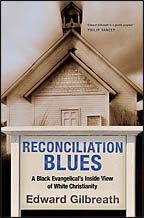
I can count on two fingers the number of books that I have read on one day – The Hobbit and, now, Reconciliation Blues by Edward Gilbreath. Granted, I read this book over the course of a day of traveling from St. Louis to NC, but the day wasn’t that long, and the book kept my attention.
I think that this is a new must-read for the Church, both for those of us who already are on board the racial reconciliation movement, and for those who are not sure or have not even begun to think about it. What I think this book does very well is that it presents the racial divide in the American Church in a way that is palatable and readable. In a review quote on the cover, Phillip Yancey calls Gilbreath a “gentle prophet”, and that description is right on. Because Gilbreath is a black man who has lived, worked, and worshipped in a largely white evangelical context, and who identifies himself with the evangelical label, he can speak with experiential authority of the struggles of minorities in the evangelical world. But rather than cast stones and bitterness, he presents his experiences in a truthful and gentle way.
Another strength of this book is its breadth. He does not get bogged down in statistics, nor does he spend a lot of time on one particular area, but instead he covers a broad swath of the evangelical world, from worship (an EXCELLENT chapter) to politics, and he also has some insightful chapters on black evangelical leaders like Martin Luther King, Tom Skinner (click to check out this talk from Tom at Urbana 70, but I would listen to it sitting down because it is amazing and jarring), and Jesse Jackson, and talks about why some/many in the evangelical world hesitate to identify Jackson, and even King, as evangelicals.
Gilbreath is a journalist and an excellent communicator, and I have found his book a terrific blend of facts and experience. While Divided By Faith is an profound and prophetic look into the state of race in the Church, readers can easily get bogged down in the numbers and sociological language, especially if they are just starting down the road of racial reconciliation. This book is easy on the eyes and challenges the heart and mind, but does not leave you feeling condemned or hopeless.
An excerpt from his chapter called The First Shall Be Last:
“Pursuing diversity is not just for the benefit of minority groups; we all stand to gain from it. But without a sustained, intentional effort to make changes, it’s easy for evangelical institutions to fall right back into their “white” default mode.
"I don’t mean to sound jaded or cynical. I understand that a big reason for this lack of a sustained intentional effort is the natural human tendency to gravitate toward that with which we’re most comfortable. But I’m also guessing that much of it has to with appeasing donors and constituencies. Money and economic control go to the systemic root of a lot of our race problems in the evangelical church – but I don’t want to dwell there. Suffice it to say, it’s risky for a nonprofit to upset its funding base. Whether it’s a matter of donors, subscribers or even chuch members, it’s a lot easier – and cheaper – to keep an existing patron than to find a new one. When Jesus said, “You cannot serve both God and Money (Matthew 6:24), he was foreshadowing one of the fundamental complications of running a Christian organization today. Ask any pastor or ministry leader – it’s a crazy balancing act. Yet it speaks to the heart of where our priorities are, and who we are as the people of God.”
Saturday, December 02, 2006
Loving Your Enemies on the Street Corner
Diane pulled up to the house and I could tell she was upset (the tears gave it away). When I asked her what happened, she told me that as she was putting up a sign for our yard sale, a homeless woman who was panhandling on the same corner began to yell at her. “Why are you putting up a sign to sell your junk at a yard sale, when I’m out here hungry? You don’t look like you’re missing many meals (she seemed to miss the fact that Diane is 32 weeks pregnant). You probably wouldn’t even help me. Don’t put up that sign.” Diane put up the sign, told the woman that she had intended to help her but wasn’t going to now, and then drove off, watching the woman pull the sign down.
When she got home she was angry and hurt and frustrated. We feel like we are one of the “good guys” when it comes to the poor, and here Diane was getting blasted by this woman for no reason. She was also upset at herself for getting so angry with the woman. I was fairly angry, too, but then, as only God can do, the chapter of Luke that I read today came to mind. In Luke 6, Jesus tells the crowds that if they love people who love them, what does that say? Even sinners know how to love people who love them back. But followers of Christ are to love their enemies. To bless when we are cursed, to do good to those who don’t do good to us. And so instead of offering to go and give the lady a piece of my mind, I offered to go and take the her some food.
But my sweet wife wouldn’t have that. Instead, she collected herself, then collected a big bag of food, and went back out to find this woman. When she found her, she got out and apologized for her attitude, and they actually hugged, and the woman apologized for how she treated Diane. Diane told her, “I know you weren’t angry at me.” And the woman said, “You’re right; I wasn’t. I’m just angry.” Diane noticed that the woman’s hand was bleeding (she had scraped it in a fall), and so she came back to the house and got her some band aids and wet wipes and Neosporin, and went back out again.
Amazing that God gives us chances to see His word prove true in action, giving us chances to let Him live through us. I could not figure out why the verses about loving our enemies stood out to me this morning – I don’t really have any enemies, and I wasn’t sure how to apply it. Then the Lord gives my wife the chance to live that out in a powerful way. How cool is that?
When she got home she was angry and hurt and frustrated. We feel like we are one of the “good guys” when it comes to the poor, and here Diane was getting blasted by this woman for no reason. She was also upset at herself for getting so angry with the woman. I was fairly angry, too, but then, as only God can do, the chapter of Luke that I read today came to mind. In Luke 6, Jesus tells the crowds that if they love people who love them, what does that say? Even sinners know how to love people who love them back. But followers of Christ are to love their enemies. To bless when we are cursed, to do good to those who don’t do good to us. And so instead of offering to go and give the lady a piece of my mind, I offered to go and take the her some food.
But my sweet wife wouldn’t have that. Instead, she collected herself, then collected a big bag of food, and went back out to find this woman. When she found her, she got out and apologized for her attitude, and they actually hugged, and the woman apologized for how she treated Diane. Diane told her, “I know you weren’t angry at me.” And the woman said, “You’re right; I wasn’t. I’m just angry.” Diane noticed that the woman’s hand was bleeding (she had scraped it in a fall), and so she came back to the house and got her some band aids and wet wipes and Neosporin, and went back out again.
Amazing that God gives us chances to see His word prove true in action, giving us chances to let Him live through us. I could not figure out why the verses about loving our enemies stood out to me this morning – I don’t really have any enemies, and I wasn’t sure how to apply it. Then the Lord gives my wife the chance to live that out in a powerful way. How cool is that?
Thursday, November 30, 2006
Is Homelessness Wrong?
Wild Willie, my anonymous random blogger who can be found posting on this site , asked the question, “Is it wrong to be homeless?” Well, first it depends on what we mean when we say “wrong.” Do we mean is it immoral? Sinful? Is it undesirable? Unsavory? Unacceptable socially? Wrong can mean different things, and I think that there are many answers, and I’ll give my best stab at a couple of them.
I don’t think it is a sin to be homeless, with sin being my definition of “wrong”. I do think that sin usually causes and sustains homelessness, whether that sin is personal, societal, familial, or a combination of those and more. People can end up on the streets because of their addictions (this is personal sin, which is often a response to numb the pain from familial or societal sin). People can end up on the streets because of mental disability (mental illness is a result of the Fall and also a societal sin of not caring well for the sick). People can end up on the streets because they lost their job or had a financial emergency and do not have the same financial safety net that I might have through family and friends (this is a result of societal sin, where wealth is predominantly concentrated among the few). People can end up on the streets because they just don’t want any rules in their life (which I think is a sign of rebellion in their spirit, which leads to rebellion against God’s authority, which is the root of sin). Children can be homeless because their parents have one of the above conditions (this is a combo of all of those above). Teens can be homeless because they are running from family or life (this is a result of their sin, familial sin, and more).
However, I have not met a homeless adult who said, “You know, the whole living in a house thing just wasn’t for me. So one day I decided to just give it all up and become homeless, because it seemed like a good idea.” (Homeless teens have sometimes given me that response, though I am not 100% certain that they believe that themselves). Certainly there are homeless now who remain in that position by choice – there are no rules, ultimate freedom (if freedom is defined as “being able to do what you want to do when you want to do it”, which I think is a poor definition of freedom). They may remain homeless by choice because they have given up hoping for anything else. They may remain homeless by choice because they are not yet sick and tired of being sick and tired. They have carved out a life for themselves on the street, and they like it that way.
Societally we do have a mentality that people should work for what they get, and we tend to not see panhandling as work, and so when we see someone with a “homeless, please help” sign on the side of the road, we tend to think that this is wrong. I don’t think that it is wrong in the sense of sinful, but is it God’s ultimate hope and plan? I just don’t know about that. It seems that we have been created with more dignity than what I see written on the faces of the homeless panhandlers – there is shame there, there is a feeling of not being productive, there is a feeling of being judged and looked down on, and work is a part of living out that dignity. Work is a good thing, given by God as part of what we do as humans.
Of course not all homeless panhandle. Some have jobs that just don’t pay living wage (societal sin); some scrape enough money to get by collecting cans and recycling them and provide just what they need. Homelessness has many more faces than I once thought, and it’s not just the people under bridges. It’s also the family that I know who has not lived in their own place in four years, and they have lived in at least 7 different places in the last two.
So is homelessness wrong? Yes. I think that it is wrong that there are people sleeping under bridged and in cars. I think that it is wrong that there is a homeless veteran in a motorized wheelchair who lives behind a gas station here. Homelessness is a sign of the brokenness of our world, of the lack of shalom (God’s peace and right living) all over our cities. A person is not in sin because they are homeless, but they are often homeless as the result of sin and brokenness, both in their own heart and life and from the sin and brokenness heaped on them by others.
I could be wrong. I’m not expert. Those are simply my two cents.
I don’t think it is a sin to be homeless, with sin being my definition of “wrong”. I do think that sin usually causes and sustains homelessness, whether that sin is personal, societal, familial, or a combination of those and more. People can end up on the streets because of their addictions (this is personal sin, which is often a response to numb the pain from familial or societal sin). People can end up on the streets because of mental disability (mental illness is a result of the Fall and also a societal sin of not caring well for the sick). People can end up on the streets because they lost their job or had a financial emergency and do not have the same financial safety net that I might have through family and friends (this is a result of societal sin, where wealth is predominantly concentrated among the few). People can end up on the streets because they just don’t want any rules in their life (which I think is a sign of rebellion in their spirit, which leads to rebellion against God’s authority, which is the root of sin). Children can be homeless because their parents have one of the above conditions (this is a combo of all of those above). Teens can be homeless because they are running from family or life (this is a result of their sin, familial sin, and more).
However, I have not met a homeless adult who said, “You know, the whole living in a house thing just wasn’t for me. So one day I decided to just give it all up and become homeless, because it seemed like a good idea.” (Homeless teens have sometimes given me that response, though I am not 100% certain that they believe that themselves). Certainly there are homeless now who remain in that position by choice – there are no rules, ultimate freedom (if freedom is defined as “being able to do what you want to do when you want to do it”, which I think is a poor definition of freedom). They may remain homeless by choice because they have given up hoping for anything else. They may remain homeless by choice because they are not yet sick and tired of being sick and tired. They have carved out a life for themselves on the street, and they like it that way.
Societally we do have a mentality that people should work for what they get, and we tend to not see panhandling as work, and so when we see someone with a “homeless, please help” sign on the side of the road, we tend to think that this is wrong. I don’t think that it is wrong in the sense of sinful, but is it God’s ultimate hope and plan? I just don’t know about that. It seems that we have been created with more dignity than what I see written on the faces of the homeless panhandlers – there is shame there, there is a feeling of not being productive, there is a feeling of being judged and looked down on, and work is a part of living out that dignity. Work is a good thing, given by God as part of what we do as humans.
Of course not all homeless panhandle. Some have jobs that just don’t pay living wage (societal sin); some scrape enough money to get by collecting cans and recycling them and provide just what they need. Homelessness has many more faces than I once thought, and it’s not just the people under bridges. It’s also the family that I know who has not lived in their own place in four years, and they have lived in at least 7 different places in the last two.
So is homelessness wrong? Yes. I think that it is wrong that there are people sleeping under bridged and in cars. I think that it is wrong that there is a homeless veteran in a motorized wheelchair who lives behind a gas station here. Homelessness is a sign of the brokenness of our world, of the lack of shalom (God’s peace and right living) all over our cities. A person is not in sin because they are homeless, but they are often homeless as the result of sin and brokenness, both in their own heart and life and from the sin and brokenness heaped on them by others.
I could be wrong. I’m not expert. Those are simply my two cents.
Saturday, November 18, 2006
They're Still Out There
Last night I had the chance to go out on Nightwatch again with the Salvation Army. In Nightwatch we visit various places where homeless people live in the city and take them some hot food, coffee, a blanket, and pray with them. We climbed under a lot of bridges and had the chance to talk with about 20 people and pray with each of them. Around 2:00 am (we started at 8:00 pm), I came home and got into bed, and a nagging thought has stayed with me from then until now – “They’re still out there.”
As I woke up at 10:00 this morning and went to take a nice hot shower, I thought, “They’re still out there.”
As I watched UNC beat State in football, I thought, “They’re still out there.”
They’re still out there – each of the men that we prayed with and gave food to are still sleeping outside on the street. One was sleeping in the front doorway of my church – we had spoken with him at about 8:30 pm, and saw him sleeping, somehow, on the concrete at 2:00 am in the cold night. There were men sleeping on pipes suspended beneath the bridges, men sleeping in abandoned trailers, men in church doorways, men on foam mattresses beneath highways, men in a shed behind a local business.
Sure, it’s nice that we gave them a warm hat and blanket and prayed with them. It’s nice that 5 Christians gave up their Friday night to do some good deeds. But for the rest of that night, and the rest of that week, those guys are still out there. And I don’t know what to do with that.
As I woke up at 10:00 this morning and went to take a nice hot shower, I thought, “They’re still out there.”
As I watched UNC beat State in football, I thought, “They’re still out there.”
They’re still out there – each of the men that we prayed with and gave food to are still sleeping outside on the street. One was sleeping in the front doorway of my church – we had spoken with him at about 8:30 pm, and saw him sleeping, somehow, on the concrete at 2:00 am in the cold night. There were men sleeping on pipes suspended beneath the bridges, men sleeping in abandoned trailers, men in church doorways, men on foam mattresses beneath highways, men in a shed behind a local business.
Sure, it’s nice that we gave them a warm hat and blanket and prayed with them. It’s nice that 5 Christians gave up their Friday night to do some good deeds. But for the rest of that night, and the rest of that week, those guys are still out there. And I don’t know what to do with that.
Thursday, November 16, 2006
Bearing Fruit
As I was praying through some Scripture this morning, a verse lept out at me in a new way. The passage was Colossians 1:10 And we pray this in order that you may live a life worthy of the Lord and may please him in every way: bearing fruit in every good work, growing in the knowledge of God, 11 being strengthened with all power according to his glorious might so that you may have great endurance and patience, and joyfully 12 giving thanks to the Father, who has qualified you to share in the inheritance of the saints in the kingdom of light.
As I prayed through verse 10, it struck me that Paul does not say "bearing the fruit of every good work." Isn't that how we usually view service to the Lord - fruit equals what I do and my works? "A tree is known by its fruit," we say, "and the fruit for a Christian is what we do."
But Paul tells us that in the midst of doing good works (which God has created us to do and prepared for us in advance, according to Ephesians 2:10), we are to baer fruit. And this gets down to the issue of the heart - when I am serving someone, am I bearing love and kindness, or am I bearing self-righteousness and duty. When I am taking time from my everyday life and want to focus on God's Kingdom and love people in hard places, am I bearing the fruit of joy or the fruit of joyless service?
GAL 5:22 But the fruit of the Spirit is love, joy, peace, patience, kindness, goodness, faithfulness, 23 gentleness and self-control. Against such things there is no law.
These are the things to bear in the midst of good works. It is so easy as Christians to think that the works are the most important thing, no matter the attitude or heart. Discipline, sacrifice, cross-bearing are important concepts in many evangelical circles. And yet Paul tells us in 1 Corinthians 13 that to do works without bearing the fruit of love makes us a gong or a cymbal, makes our works impotent. To divorce the concepts of sacrifice and discipline from the fruit of the Spirit (rather than having those empowered and enabled by the Spirit) is to regress into being people under law, not the freedom of Christ.
May we, you and I, be a people who do not grow weary in doing good, and as we do good, may we bear the fruit of the Spirit, that God might be glorified and seen, not our works themselves.
As I prayed through verse 10, it struck me that Paul does not say "bearing the fruit of every good work." Isn't that how we usually view service to the Lord - fruit equals what I do and my works? "A tree is known by its fruit," we say, "and the fruit for a Christian is what we do."
But Paul tells us that in the midst of doing good works (which God has created us to do and prepared for us in advance, according to Ephesians 2:10), we are to baer fruit. And this gets down to the issue of the heart - when I am serving someone, am I bearing love and kindness, or am I bearing self-righteousness and duty. When I am taking time from my everyday life and want to focus on God's Kingdom and love people in hard places, am I bearing the fruit of joy or the fruit of joyless service?
GAL 5:22 But the fruit of the Spirit is love, joy, peace, patience, kindness, goodness, faithfulness, 23 gentleness and self-control. Against such things there is no law.
These are the things to bear in the midst of good works. It is so easy as Christians to think that the works are the most important thing, no matter the attitude or heart. Discipline, sacrifice, cross-bearing are important concepts in many evangelical circles. And yet Paul tells us in 1 Corinthians 13 that to do works without bearing the fruit of love makes us a gong or a cymbal, makes our works impotent. To divorce the concepts of sacrifice and discipline from the fruit of the Spirit (rather than having those empowered and enabled by the Spirit) is to regress into being people under law, not the freedom of Christ.
May we, you and I, be a people who do not grow weary in doing good, and as we do good, may we bear the fruit of the Spirit, that God might be glorified and seen, not our works themselves.
Monday, October 30, 2006
All I have to offer
All I have to offer
Today I was stopped by one of our tutoring parents whose daughter started attending a few weeks ago. She asked me if our church provided financial assistance because she and her two girls were about to be evicted. As we talked, I learned that the father of her kids is supposed to give $650 a month in child support, but he has gone into hiding. So she is making due by working 37 hours every two weeks at $6.25 an hour, or $462 a month before taxes . Simple math tells us that, with her rent being $600 per month, she is not making ends meet, and even with child support, her monthly income would be almost 1/3 of what I make.
I was grieved when I came home, knowing that in about 24 hours or so, my month’s salary would “magically” appear in my bank account via direct deposit, and all my bills would be paid for, and soon our “new” minivan would be paid off (yes, I have now entered the Minivan Stage of life). While I didn’t feel guilty for what Diane and I have, the stark contrast between my life, and the life of this family really hit me. Her daughter who attends our program is such a sweet kid, and to think of the transitions that she has endured even in recent months (living in a hotel for four months before moving to this house) makes me cry. How can a child go through that and not shut down their heart? How can a parent who is facing such obstacles greet me at the door with a smile on her face?
I had to tell her that our church can’t help them right now and pointed her to the Greensboro Housing Coalition, and then we prayed on her front porch. It was all I had to offer, and, correct theology aside, I felt that it wasn’t enough. And yet I am thankful to be here, because prayer is what she needs. More than a check. More than a new house. She needs to be reminded that there is a God who cares, who loves her dearly, and who will take care of her and her family. It truly was all I had to offer, and it was all that she needed.
Today I was stopped by one of our tutoring parents whose daughter started attending a few weeks ago. She asked me if our church provided financial assistance because she and her two girls were about to be evicted. As we talked, I learned that the father of her kids is supposed to give $650 a month in child support, but he has gone into hiding. So she is making due by working 37 hours every two weeks at $6.25 an hour, or $462 a month before taxes . Simple math tells us that, with her rent being $600 per month, she is not making ends meet, and even with child support, her monthly income would be almost 1/3 of what I make.
I was grieved when I came home, knowing that in about 24 hours or so, my month’s salary would “magically” appear in my bank account via direct deposit, and all my bills would be paid for, and soon our “new” minivan would be paid off (yes, I have now entered the Minivan Stage of life). While I didn’t feel guilty for what Diane and I have, the stark contrast between my life, and the life of this family really hit me. Her daughter who attends our program is such a sweet kid, and to think of the transitions that she has endured even in recent months (living in a hotel for four months before moving to this house) makes me cry. How can a child go through that and not shut down their heart? How can a parent who is facing such obstacles greet me at the door with a smile on her face?
I had to tell her that our church can’t help them right now and pointed her to the Greensboro Housing Coalition, and then we prayed on her front porch. It was all I had to offer, and, correct theology aside, I felt that it wasn’t enough. And yet I am thankful to be here, because prayer is what she needs. More than a check. More than a new house. She needs to be reminded that there is a God who cares, who loves her dearly, and who will take care of her and her family. It truly was all I had to offer, and it was all that she needed.
Tuesday, October 10, 2006
50
So to continue with my numerical posts (See "80" and "40"), I am continuing to see God's hand at work teaching me through the tutoring ministry. A few weeks ago we only had 40 total tutors (about 20 each day), and I was leaving our time each week exhausted, drained, and unhappy. I thought that the answer was to get more tutors, but God had different plans. My unhappiness led me to talk with a pastor at my church who helped me realize that God has not gifted me in management and administration, but rather I am a visionary and a shepherd. Operating outside of my gift mix was sucking the life out of me, and he said something that gave me pause. "You've taken this ministry as far as you can take it." My first reaction was to think, "What? I can do bettter; who else could do this. If I stepped into a different role, what would I do?" But as we continued to talk, I began to realize that having someone come in to administrate would free me up to love the kids and love the tutors who are helping, and it could allow us to get to a point where more children and volunteers could get involved. I made plans to meet with a woman in our church who is an excellent administrator and business leader, and she is going to help restructure our program.
Within a week of this conversation, our tutor numbers began to go up, and we now have ove 50 (close to 60) tutors helping. Things have settled and I no longer feel overwhelmed. And I praise God that He did not give us 80 tutors right off the bat, because if He had, I most likely would not have gotten overwhelmed to the point of asking for help and seeing my limitations. He needed to show me where this program needed to grow and the ways that I couldn't get it there, and once that was accomplished, He has provided relief.
All this to say, I thought I knew what was best for the ministry and what I needed, but God has a bigger vision and a bigger plan than just survival in the right now. He is a God who builds and looks beyond what we see, and sometimes has to bring us to our knees for us to see that as well.
Sunday, October 08, 2006
Eliza-isms
From a baby-sitter:
Scott called to tell he didnt need a ride and before I hung up i said "i love you".
Eliza: was that your sweetheart?
Me: yes
Eliza: does he belong to you at your house?
Me: no, he has his own house
Eliza: well is he your husband?
Me: no just a good friend
Eliza: well i never heard of that. now is he a boy or a girl?
Tuesday, October 03, 2006
Relearning the secret
The past week or so has been a struggle for me. I think that the word that best describes the time would be "discontent." I was discontented with my friendships, longing for more than I was experiencing here in Greensboro. I was discontented with my house - if we could just re-do the bathroom and do some painting here and there and magically create a playroom for the girls, then I would be happy. I was discontented with our family car and the options for what we would buy next based on the money we have saved. I was discontented with my job, not enjoying tutoring or the leadership meetings I attended last week. I was discontented with my fantasy football team (having Daunte Culpepper as your QB in BOTH leagues that you're in will do that). I was discontented with my disc golf scores (despite getting to play on absolutely GORGEOUS days). You name it, I was discontented with it.
This is no surprise given the fact that I had spent very little time with the Lord in that stretch, and had begun to depend on myself and my abilities to make life work (which is no surprise, since if I am not dependent on the Lord, where else can I turn but to myself). I was churning inside, overwhelmed and tired from trying to keep everything together. Thankfully, the Holy Spirit broke through, reminded me of what I needed, and led me to set the alarm to get up early yesterday morning to spend time with my Father. As I poured out my discontent into my journal and read Ephesians 5, the contrast between the truth of God and the lies I was believing became more and more stark. For example, when I believe that it is up to us to save a certain amount of money and scheme to buy the most amazing $6000 car ever, I am not living in the Truth that God, my Father, is my provider. I don't have to provide for myself, nor can I. I am God's son, a child of light, no longer darkness, no longer and orphan or His enemy. I am a dearly loved child of God. Will my God not provide for me in love?
Phillipians 4:13 is a widely-quoted, much loved verse which says, "I can do all things through Christ who gives me strength." But it was only a few years ago that I realized that this verse came in the context of Pauls saying, "11I am not saying this because I am in need, for I have learned to be content whatever the circumstances. 12I know what it is to be in need, and I know what it is to have plenty. I have learned the secret of being content in any and every situation, whether well fed or hungry, whether living in plenty or in want."
The secret is Jesus Christ. Through Him. In Him. When my eyes are on Jesus, contentment is mine because I remember that in Him I have all I need for life and Godliness (2 Peter 1:3). It seems so simple, even as I write it out, but I have recently seen again that it is so true. The secret of being content in all things is Christ.
This is no surprise given the fact that I had spent very little time with the Lord in that stretch, and had begun to depend on myself and my abilities to make life work (which is no surprise, since if I am not dependent on the Lord, where else can I turn but to myself). I was churning inside, overwhelmed and tired from trying to keep everything together. Thankfully, the Holy Spirit broke through, reminded me of what I needed, and led me to set the alarm to get up early yesterday morning to spend time with my Father. As I poured out my discontent into my journal and read Ephesians 5, the contrast between the truth of God and the lies I was believing became more and more stark. For example, when I believe that it is up to us to save a certain amount of money and scheme to buy the most amazing $6000 car ever, I am not living in the Truth that God, my Father, is my provider. I don't have to provide for myself, nor can I. I am God's son, a child of light, no longer darkness, no longer and orphan or His enemy. I am a dearly loved child of God. Will my God not provide for me in love?
Phillipians 4:13 is a widely-quoted, much loved verse which says, "I can do all things through Christ who gives me strength." But it was only a few years ago that I realized that this verse came in the context of Pauls saying, "11I am not saying this because I am in need, for I have learned to be content whatever the circumstances. 12I know what it is to be in need, and I know what it is to have plenty. I have learned the secret of being content in any and every situation, whether well fed or hungry, whether living in plenty or in want."
The secret is Jesus Christ. Through Him. In Him. When my eyes are on Jesus, contentment is mine because I remember that in Him I have all I need for life and Godliness (2 Peter 1:3). It seems so simple, even as I write it out, but I have recently seen again that it is so true. The secret of being content in all things is Christ.
Friday, September 29, 2006
Up and down on the Bus Tour
Yesterday I went on the Greensboro Housing Coalition’s “Healthy Homes Bus Tour.” This was the third annual Tour, and basically we rode around Greensboro on chartered buses to see homes that either had been improved due to the Housing Coalition’s efforts or homes that still needed work. It was very encouraging to see how the Coalition really is having an effect in terms of getting slumlords to comply with basic housing codes on their buildings and to see how Habitat for Humanity is making an impact on existing homes through its Home Repair program. There were some truly awful houses that have been either knocked down (and the tenants relocated to better homes) or repaired, and they seem to be on their way to reducing substandard housing in Greensboro by 50% by the year 2008.
However, inside I was so up and down as far as urban ministry goes (granted, I was pretty close to exhausted following being out of town for a few days).
As we drove through a neighborhood not far from mine, yet in considerably more disarray, I got excited looking at the houses there, seeing them as they could be and not as they are, and I felt excitement over possibly living there.
On the other hand, as we toured the city, most of the homes that needed work or had been neglected were in parts of town where mostly black or Hispanic people lived. The dividing line of race and class was so clear, almost as though I had not seen it before, and it broke my heart. It’s like there are two worlds in Greensboro and it feels as though the divide is unbridgeable. It’s not just a black-white divide. It’s money and privilege and ignorance and crime and more.
The last house we looked at was in a nicer neighborhood near UNCG with houses that probably are worth over $200,000. As we drove those streets, my heart longed to live there, to have shady sidewalks bordered by well-kept lawns, where things are quiet and orderly and predictable, where there was aesthetic beauty all around and just a peace that comes from life being similar to how it was when I was growing up. I was so sad that this was not my home and that this was not the part of town that I was called to, and I was sad that my heart was still so drawn to that part of life, even after five years living and serving here.
Not sure what to do with all I felt or whether most of that was emotion brought on by being tired. But my heart was heavy as I got off the bus and headed home. I’m so thankful that when I came in my door here on Silver Avenue, I had such a sweet family excitedly waiting to greet me!
However, inside I was so up and down as far as urban ministry goes (granted, I was pretty close to exhausted following being out of town for a few days).
As we drove through a neighborhood not far from mine, yet in considerably more disarray, I got excited looking at the houses there, seeing them as they could be and not as they are, and I felt excitement over possibly living there.
On the other hand, as we toured the city, most of the homes that needed work or had been neglected were in parts of town where mostly black or Hispanic people lived. The dividing line of race and class was so clear, almost as though I had not seen it before, and it broke my heart. It’s like there are two worlds in Greensboro and it feels as though the divide is unbridgeable. It’s not just a black-white divide. It’s money and privilege and ignorance and crime and more.
The last house we looked at was in a nicer neighborhood near UNCG with houses that probably are worth over $200,000. As we drove those streets, my heart longed to live there, to have shady sidewalks bordered by well-kept lawns, where things are quiet and orderly and predictable, where there was aesthetic beauty all around and just a peace that comes from life being similar to how it was when I was growing up. I was so sad that this was not my home and that this was not the part of town that I was called to, and I was sad that my heart was still so drawn to that part of life, even after five years living and serving here.
Not sure what to do with all I felt or whether most of that was emotion brought on by being tired. But my heart was heavy as I got off the bus and headed home. I’m so thankful that when I came in my door here on Silver Avenue, I had such a sweet family excitedly waiting to greet me!
Friday, September 22, 2006
Run, don't walk, to Blockbuster (or your Netflix que)

It's 10:35 pm on Friday night and I have about an hour of prep left before an evangelism training at Elon University tomorrow. But instead I am blogging, because Diane and I just watched a movie that I hope everyone who reads this will see if they have not. It's called "Akeelah and the Bee", and I can't tell you how much we enjoyed it. When I saw it advertised in Starbucks, I thought it was a cartoon about a bee and some Dora-the-Explorer-like girl, and even if I had read the fine print and learned it was about a spelling bee, I might have taken a pass. But this movie is about much more than simply the story of a girl who goes to the national spelling bee, because Akeelah happens to live in the Crenshaw section of LA, attending a school where they can't afford to put doors on the bathroom stalls. Her mom is struggling to keep her family together and in line, and Akeelah is a brilliant 11-year-old struggling between the goal of fitting in and blending in at her middle school, and the desire to win a national spelling competition.
So much of this movie resonated with us just from our experiences with kids and families here in Glenwood (which is certainly not Crenshaw, but many issues are the same), and what made my heart really sing is it spoke again a hopeful message that one at a time, people and families can be transformed. The layers and layers of her family and history are so neat to see as well - on first glance, you would see single mom, gang-banger son, daughter with a baby and no dad around, and you would just discount them. But as you learn more, their story and struggle is so much more complex. And this movie portrays community as so vital to the success of its members, which really excited and inspired me.
Even if you don't live in a neighborhood like Akeelah's (or Glenwood), you will be inspired by this story and entertained as well. Check it out.
Monday, September 18, 2006
Passive resistance circa 2006
Today I went into the K-2 room of our tutoring program to find one of our little girls lying on the floor crying. "Susie, get up," I said. No answer, no movement. "Susie, get up right now or you will lose your snack." No answer, no movement. This continues for a few more rounds until I have to pick her up and carry her to a chair. Then I ask her, "Do you know why you're not getting snack today?" No answer. Repeat five times. No answer. I can't take her home because her mom is not there (which brings up the subject of two kids under the age of seven at home alone all afternoon, but that is for another post). I can't spank her or send her to the principal or flunk her. She didn't answer, didn't look at me didn't move, and I was really not sure what to do short of carrying her outside to the free time area where most of the other kids were. Finally she decided to walk out there (still not talking) after I picked her up and made her begin to walk.
Later, I thought about the sit-in movements and the passive resistance tactics of the 60's and realized why they were effective. If you don't answer, don't move, just sit, there isn't a whole lot anyone can do with you. I just wish I hadn't faced it during our after school program.
Later, I thought about the sit-in movements and the passive resistance tactics of the 60's and realized why they were effective. If you don't answer, don't move, just sit, there isn't a whole lot anyone can do with you. I just wish I hadn't faced it during our after school program.
Saturday, September 16, 2006
All you need is love
After speaking at Duke's IV meeting this Friday, one of the students came up to talk. Over the course of talking, the topic of evangelism came up, and she began sharing how she had kind of sequestered herself away from non-Christians since she had been at school. She said that she didn't know how to share her faith very well and that she tended to get defensive when talking with non-Christians. But as we continued to talk, we began to zero in more and more on what the problem really was. It wasn't a lack of apologetics knowledge or a tendency to get defensive. Ultimately she had wandered from intimacy with Jesus, replacing a loving relationship with her Father with a boring, religious list of things to do. And so evangelism for her was not an expression of the love of Jesus that she was receiving; it was something that she ought to do. She had thought that evangelism was all up to her, and the concept of depending on Jesus to love her non-Christian friends through her was so foreign.
She said that for a couple of years she had been asking God to give her a passion for Him; I imagine that she thought that was a feeling or a zeal for the Lord. But perhaps, I told her, what she needed to ask God for was not a feeling of passion, but rather a knowing that the Lord loved her.
My heart went out to her, because I longed for her to be set free to know more deeply the love of Jesus. That is the only thing to change and transform her heart. That is the only thing that would compel her to share her faith with her non-Christian friends.
I just found it interesting to be reminded that for most of us, a lack of evangelistic zeal or effort is not primarily linked to lack of knowledge or training or even "I ought to's". But rather it is linked to our awareness of and soaking in the Love of the Father given to us through Christ.
She said that for a couple of years she had been asking God to give her a passion for Him; I imagine that she thought that was a feeling or a zeal for the Lord. But perhaps, I told her, what she needed to ask God for was not a feeling of passion, but rather a knowing that the Lord loved her.
My heart went out to her, because I longed for her to be set free to know more deeply the love of Jesus. That is the only thing to change and transform her heart. That is the only thing that would compel her to share her faith with her non-Christian friends.
I just found it interesting to be reminded that for most of us, a lack of evangelistic zeal or effort is not primarily linked to lack of knowledge or training or even "I ought to's". But rather it is linked to our awareness of and soaking in the Love of the Father given to us through Christ.
Wednesday, September 13, 2006
40
So a couple posts back I had this awesome, exciting news that over 110 people had expressed interest in tutoring this year, and how I had prayed for at least 80 people to help, and how amazed I was at God answering that prayer.
As of this week we have 40 tutors TOTAL (approximately 20 each day) for the 40-plus kids that attend our program, leaving us again at a one-on-two situation.
I've been kind of running from this contrast of 40 and 80, running from the exuberance of thinking that my prayer had quickly and easily been answered. I haven't know what to do with the reality that we still don't have enough folks, even though I asked with "freedom and confidence" like it says in Ephesians 3. I haven't known what to do with the nagging thought, "Well, see, I didn't quite pray enough."
Tutoring goes on and we make the best of what we have. God has provided 40, and that is great news for us. But something in me is afraid to admit that I feel let down or that I got excited too soon, and the temptation is to default into a more cautious posture from now on when asking for needs to be met. To try and not get my hopes up. To be "realistic" (also known as cynical).
But I remember my systematic theology professor teaching us that to live cynically and hopelessly is to be lazy in our faith. Who hopes for what he already has? To live with hope is crazy, it is work, and it is our call as Christians, for we are never without it.
Where are the other 40? I don't know. But I am thankful for God's provision thus far and I live with the hope that He will continue to provide one way or the other.
As of this week we have 40 tutors TOTAL (approximately 20 each day) for the 40-plus kids that attend our program, leaving us again at a one-on-two situation.
I've been kind of running from this contrast of 40 and 80, running from the exuberance of thinking that my prayer had quickly and easily been answered. I haven't know what to do with the reality that we still don't have enough folks, even though I asked with "freedom and confidence" like it says in Ephesians 3. I haven't known what to do with the nagging thought, "Well, see, I didn't quite pray enough."
Tutoring goes on and we make the best of what we have. God has provided 40, and that is great news for us. But something in me is afraid to admit that I feel let down or that I got excited too soon, and the temptation is to default into a more cautious posture from now on when asking for needs to be met. To try and not get my hopes up. To be "realistic" (also known as cynical).
But I remember my systematic theology professor teaching us that to live cynically and hopelessly is to be lazy in our faith. Who hopes for what he already has? To live with hope is crazy, it is work, and it is our call as Christians, for we are never without it.
Where are the other 40? I don't know. But I am thankful for God's provision thus far and I live with the hope that He will continue to provide one way or the other.
Tuesday, September 12, 2006
Embracing my inner Ricky Bobby

I got the most awesome birthday present this weekend - a bunch of family members and friends chipped in and got me a chance to do the Richard Petty Driving Experience ! Those of you who know me well know that I actually do enjoy NASCAR and have for quite some time, and I love seeing how fast those cars go and imagining that I was driving one.
I used to mow the grass at home in Statesville and pretend I was Dale Earnhardt, Sr (there was no need to say "Sr" then because "Junior" was still just a kid) slicing my way to the front at Daytona. So the idea of first getting to ride at over 150 MPH around a speedway and then also getting to DRIVE a car that fast (I hope) around one is just awesome.
The day I got my present I was sitting outside just looking out at the street and grinning, and Diane said, "Are you thinking about driving that car?" Yes indeedy.
Maybe a NASCAR talent scout will see me and sign me to drive the Zondervan TNIV Study Bible Chevrolet, with co-sponsors Innova Golf Discs, the UNC Tar Heels basketball team, and Cheerwine. Look, momma, I'm goin' fast!
Thursday, September 07, 2006
Quiet and Confused
It’s quiet around here – too quiet. Three nights a week I run in a nearby neighborhood (just feels a little safer) and in years past I would lament at how much quiet-er and “normal” it seemed from Glenwood. But last night I noticed that my street was equally quiet as this other place, and that was strange. Glenwood is very quiet lately – few police sirens (I don’t even see them quietly patrolling as much), fewer cars with loud bass, fewer people walking by our house yelling and cursing.
As I have seen this place change, it makes me wonder about the Benbow’s future here. I think that I have moved forward a great deal in not placing my personal identity in urban ministry (see Saying Bye to 'Urban Guy') but from a vocational standpoint, I am kind of tied to living among the poor for part of my urban job. One of the ways that GUPY students learn is from the opportunity to see and apply Biblical truths about loving the poor in the place where they live. As the poor move to other parts of the city and landlords buy up properties and rent them to more UNCG-related people, the GUPY experience begins to lose some of its relevance.
As I think about this, thoughts of moving to another poor neighborhood surface, and when they come, I just think that there is no way that I can do that again. Our first year or two here was so hard, scary, and lonely that I wonder if I could go to a new place and face those fears and discomforts all over again. But can I host something like GUPY in a place like Glenwood? Certainly there could be some creative solution, but I don’t see it.
Also as I think about moving and possibly replicating our strategy of reaching children via a tutoring program, I don’t know how that would work either. We have close to 50 kids who could potentially be coming to tutoring next week, and close to ½ of those live more than a mile outside my neighborhood (which is not far, but they are not right around the corner, either). When kids move away from Glenwood, we keep up with them, and continue to bring them to tutoring. So relocating to a new area with new kids would add to the 40-plus kids we are already serving right now.
In short, I am very confused. Diane and I have a dream of having a house near our home for college students to live in year-round, loving our neighbors with us. There is a possibility here in Glenwood, but should we pursue it? Is this neighborhood the place for that dream or is it somewhere else? If we moved somewhere else, would other members of our church go with us from the start this time so that we don’t feel so lonely and isolated for the first year?
Prayers for clarity, patience, and hearing from the Lord, along with a heart to obey despite my own fears and dreams, would be much appreciated.
As I have seen this place change, it makes me wonder about the Benbow’s future here. I think that I have moved forward a great deal in not placing my personal identity in urban ministry (see Saying Bye to 'Urban Guy') but from a vocational standpoint, I am kind of tied to living among the poor for part of my urban job. One of the ways that GUPY students learn is from the opportunity to see and apply Biblical truths about loving the poor in the place where they live. As the poor move to other parts of the city and landlords buy up properties and rent them to more UNCG-related people, the GUPY experience begins to lose some of its relevance.
As I think about this, thoughts of moving to another poor neighborhood surface, and when they come, I just think that there is no way that I can do that again. Our first year or two here was so hard, scary, and lonely that I wonder if I could go to a new place and face those fears and discomforts all over again. But can I host something like GUPY in a place like Glenwood? Certainly there could be some creative solution, but I don’t see it.
Also as I think about moving and possibly replicating our strategy of reaching children via a tutoring program, I don’t know how that would work either. We have close to 50 kids who could potentially be coming to tutoring next week, and close to ½ of those live more than a mile outside my neighborhood (which is not far, but they are not right around the corner, either). When kids move away from Glenwood, we keep up with them, and continue to bring them to tutoring. So relocating to a new area with new kids would add to the 40-plus kids we are already serving right now.
In short, I am very confused. Diane and I have a dream of having a house near our home for college students to live in year-round, loving our neighbors with us. There is a possibility here in Glenwood, but should we pursue it? Is this neighborhood the place for that dream or is it somewhere else? If we moved somewhere else, would other members of our church go with us from the start this time so that we don’t feel so lonely and isolated for the first year?
Prayers for clarity, patience, and hearing from the Lord, along with a heart to obey despite my own fears and dreams, would be much appreciated.
Tuesday, August 29, 2006
80
Our church is studying Ephesians right now in our sermon times, and we just finished Ephesians 3:1-14. Verse 13 tells us that "in Him (Christ) and through faith in Him, we may approach God with freedom and confidence." When I first heard this, I was very excited that I had the freedom and confidence to ask God to help me with things in my life that need work, help, etc. This is a reasssuring truth indeed. But this morning as I was going over the text again, I realized that with freedom and confidence can come boldness and even crazy prayers that we might not normally pray. If I have FREEDOM to ask anything and CONFIDENCE that God hears and loves me, why are my prayers so small most of the time? God spoke to me and told me that I need to ask Him for what to pray, because left to myself I will stop short of asking for the things that I think are too big to be done.
After that Sripture time, I opened a Word document entitled "80" that I had typed on April 26th and then not opened again, mostly (I have to admit) because it seemed so ludicrous. In a moment of crazy boldness and freedom, I typed a prayer, asking God to send us 80 tutors for this coming year, so that each day we would have 40 tutors for the 40 kids that we hope will come. Kids need one on one help to best succeed and many times in years past we have been one on three, one on two at best.
I opened "80" this morning, because today on email I received our initial database of interested tutors, and there are 83 on the list. Some of them may decide to not help (like, say. 3?), but as I looked at that list, which more than doubled the number that we had last year, I remembered "80" and how I was afraid to look at that document or share it with others because "what if God didn't answer".
We as God's children have FREEDOM and CONFIDENCE through our perfect access in Christ Jesus. We can ask the Father anything, no matter how big (or how small), and we know that He hears and He doesn't laugh us off or ignore us. And, surprise, He even answers despite the fact that our faith is maybe 64% sure that He will. Let's be a people who are bold and ask God to do more than we can ask or imagine.
After that Sripture time, I opened a Word document entitled "80" that I had typed on April 26th and then not opened again, mostly (I have to admit) because it seemed so ludicrous. In a moment of crazy boldness and freedom, I typed a prayer, asking God to send us 80 tutors for this coming year, so that each day we would have 40 tutors for the 40 kids that we hope will come. Kids need one on one help to best succeed and many times in years past we have been one on three, one on two at best.
I opened "80" this morning, because today on email I received our initial database of interested tutors, and there are 83 on the list. Some of them may decide to not help (like, say. 3?), but as I looked at that list, which more than doubled the number that we had last year, I remembered "80" and how I was afraid to look at that document or share it with others because "what if God didn't answer".
We as God's children have FREEDOM and CONFIDENCE through our perfect access in Christ Jesus. We can ask the Father anything, no matter how big (or how small), and we know that He hears and He doesn't laugh us off or ignore us. And, surprise, He even answers despite the fact that our faith is maybe 64% sure that He will. Let's be a people who are bold and ask God to do more than we can ask or imagine.
Monday, August 28, 2006
Administering grace
Somehow over the past months (not sure how long it has been really), I have gotten out of the habit of walking my neighborhood. I blamed it on being too tired to get up early with Joe, and then in the evenings I am too busy helping Diane with the girls. But the truth is that somehow, some way, fear had crept back in and was keeping me at home. Or maybe it was apathy. Or a mix of both. I know that there is little to fear here in Glenwood, especially in recent months as the streets have been cleaned up more and more. But maybe my fear has been the fear of being bothered. The fear of being stopped and talked to. The fear of seeing more needs that I just can’t meet. The fear of a new crop of neighbors and hanger-out-ers that I don’t know very well. And so I would rather stay in my little controlled world.
In the past, enough folks came by my controlled world so as to make it easy for me to love those that we moved here for. But foot traffic patterns have changed, and those folks are elsewhere, and so opportunities to share the love of Christ have been fewer. I’ve been feeling this for a while, not able to put my finger on exactly what was demotivating me and not able to muster up a good motivation to get going again.
But this Sunday our pastor preached on Ephesians 3:1-14, and in the early verses of that chapter, Paul talks about the administration of God’s grace given to him for the sake of the Gentiles. I had always thought this meant that God had administered grace to Paul for the sake of the Gentiles (and theologically that is true). But in the Greek, that particular instance of administer means “to be a manager of.” Paul is saying that he is a manager of grace from God, given the task of passing it on and utilizing it to bless others. Our pastor exhorted us, from a position of the Good News and our identity in Christ as motivation, to be good managers of the grace God has given us. And I realized that in many ways I was squirreling away the grace and time and opportunity of being here in Glenwood.
As I walked through the park tonight, there were a number of kids there and some middle school-ers (an intimidating age group in any neighborhood), and I thought, “God has given me grace to manage here. I have grace and gifts that are meant for these kids, for their families.” And the thought carried no guilt. It carried hope and purpose, and felt as thought it were leading me on that walk.
I want to be here on purpose and with purpose, and I need prayer and encouragement to walk the streets with Joe (our boxer) again, remembering that I am a manager of God’s grace, submitting my time and my plans to God’s desires to use me in the lives of others. And I wouldn’t be surprised to see that grace gets administered back to me from those I meet along the way.
(incidental note: this is post #100)
In the past, enough folks came by my controlled world so as to make it easy for me to love those that we moved here for. But foot traffic patterns have changed, and those folks are elsewhere, and so opportunities to share the love of Christ have been fewer. I’ve been feeling this for a while, not able to put my finger on exactly what was demotivating me and not able to muster up a good motivation to get going again.
But this Sunday our pastor preached on Ephesians 3:1-14, and in the early verses of that chapter, Paul talks about the administration of God’s grace given to him for the sake of the Gentiles. I had always thought this meant that God had administered grace to Paul for the sake of the Gentiles (and theologically that is true). But in the Greek, that particular instance of administer means “to be a manager of.” Paul is saying that he is a manager of grace from God, given the task of passing it on and utilizing it to bless others. Our pastor exhorted us, from a position of the Good News and our identity in Christ as motivation, to be good managers of the grace God has given us. And I realized that in many ways I was squirreling away the grace and time and opportunity of being here in Glenwood.
As I walked through the park tonight, there were a number of kids there and some middle school-ers (an intimidating age group in any neighborhood), and I thought, “God has given me grace to manage here. I have grace and gifts that are meant for these kids, for their families.” And the thought carried no guilt. It carried hope and purpose, and felt as thought it were leading me on that walk.
I want to be here on purpose and with purpose, and I need prayer and encouragement to walk the streets with Joe (our boxer) again, remembering that I am a manager of God’s grace, submitting my time and my plans to God’s desires to use me in the lives of others. And I wouldn’t be surprised to see that grace gets administered back to me from those I meet along the way.
(incidental note: this is post #100)
Wednesday, August 16, 2006



It's a ......
Boy!
We had the ultra-sound this morning. For a long time I had really wanted a son, but in some ways had believed a lie that God wouldn't give me a son because maybe I wasn't cut out for it. He has been addressing that, teaching me about my security in Him, and the other week I was able to say, "Lord, I really would like to have a son, you know that, but if you give us a girl, I will receive her and rejoice at your gift to us." So while I was certainly anxious to see if we were having a boy or a girl, I was at peace with the Lord's plan for us. Diane and I do rejoice with this news, and are thankful that my office (soon to be our son's room) is already painted blue.
We had the ultra-sound this morning. For a long time I had really wanted a son, but in some ways had believed a lie that God wouldn't give me a son because maybe I wasn't cut out for it. He has been addressing that, teaching me about my security in Him, and the other week I was able to say, "Lord, I really would like to have a son, you know that, but if you give us a girl, I will receive her and rejoice at your gift to us." So while I was certainly anxious to see if we were having a boy or a girl, I was at peace with the Lord's plan for us. Diane and I do rejoice with this news, and are thankful that my office (soon to be our son's room) is already painted blue.
Monday, August 14, 2006
Reconciliation: it ain't just for preachin' anymore
For years now I have loved leading students and staff in learning the Biblical basis for racial reconciliation. Passages like Ephesians 2:11-22 really spell out that the work of the cross was not just a vertical reconciliation *man to God* but also a horizontal reconciliation *man to man*. (For an excellent sermon on this passage, you can listen to Solving the Biggest Problem in the World [the July 16th sermon on that page].)
I love watching people’s faces as they realize that the work of reconciliation is not something that we have to accomplish but rather a reality for us to live out. Jesus HAS DESTROYED the dividing wall and HAS MADE the two one, putting to death their hostility. The study is so applicable to the divide between races in America, especially black and white in the South, and I am encouraged to pray big prayers and believe big truths when looking at the power of the cross to reconcile any and all people across all lines.
But I have to admit that sometimes it is safer to relegate that finished work of reconciliation to racial issues. For me it’s easy to believe that the cross has truly canceled the dividing wall between black and white; it’s easy to hope that one day people of all colors will walk in the reality of unity that Jesus has won. But when it comes to applying that to my own sin, my own brokenness and how that affects my family and friends, well, I am reluctant to trust the fullness of the cross. In effect I say, “Well, sure Jesus paid for racial sins, and we can be reconciled, but I am not sure if the cross is big enough to handle my _____ (insert gross sin here).”
I know that good theology (and a great hymn) says that my sin, not in part but the whole, is nailed to the cross and I bear it no more. But I am also tempted to believe that the resulting relational brokenness between me and those that I hurt is too great. One day it will be fixed, in heaven, but for now it is best to just look the other way and try not to bring it up.
And so the Evil One divides me from people, shaming me into hiding my sin and just dealing with it on a me-and-Jesus basis. He tells me that to bring it fully into the light would be too hurtful. It would create too much pain, too much shame, too much brokenness and the best thing to do is just hide. Confession should be left to popular sins like pride or materialism or generic words like “lust” or “envy.”
Believing that lie had been costing me intimacy with my wife, intimacy with the Father, and intimacy with friends. I chose to embrace my shame and own it as my own, and not lean into the fullness of the cross, the truth that Jesus had, indeed, paid for all my sin and had, indeed, reconciled me to all those I had hurt.
But praise God for His tender, unrelenting Spirit, which continued to work on my heart, calling me into the light, and calling me to really test and see if the cross was as big and as good as I said it was. I teach students all the time about how completely free they are in Christ, but until this spring, I was not willing to lean into that freedom and see if it would indeed catch me as I fell.
Now it is true that the initial process of confession was not easy. It hurt, and it seemed produced more brokenness than healing at the outset. And the Evil One said, “See. Look at how awful you are. You should be ashamed. Better hide this from everyone else.”
But the Spirit had other plans. He said, “Your name is no longer Shame . It is Chosen. And because it is Chosen, you can lean into my love, my complete forgiveness, and you can pursue the reconciliation that you preach.”
And so I confessed again, bringing full disclosure to all that I had sinned against, and I shrank back, waiting for the hammer to fall. What fell was grace. Forgiveness. Love. I was received with open arms, looked in the eye and restored, loved with tenderness and commitment.
As the Spirit has led and light has been shed, chains have come off. Strongholds have been broken. And I am experiencing freedom and intimacy with Lord, my wife, and others that I have not had for years.
Don’t believe the lie that there are sins too big for the Cross. Don’t believe the lie that your name is Shame. The Lord has paid in full and is in the business of reconciliation. Yes across racial and cultural lines. But also across lines of brokenness for ordinary, regular lives like yours and mine. The Evil One would love to see us bound, divided and shamed. Confession and light make that darkness flee.
I love watching people’s faces as they realize that the work of reconciliation is not something that we have to accomplish but rather a reality for us to live out. Jesus HAS DESTROYED the dividing wall and HAS MADE the two one, putting to death their hostility. The study is so applicable to the divide between races in America, especially black and white in the South, and I am encouraged to pray big prayers and believe big truths when looking at the power of the cross to reconcile any and all people across all lines.
But I have to admit that sometimes it is safer to relegate that finished work of reconciliation to racial issues. For me it’s easy to believe that the cross has truly canceled the dividing wall between black and white; it’s easy to hope that one day people of all colors will walk in the reality of unity that Jesus has won. But when it comes to applying that to my own sin, my own brokenness and how that affects my family and friends, well, I am reluctant to trust the fullness of the cross. In effect I say, “Well, sure Jesus paid for racial sins, and we can be reconciled, but I am not sure if the cross is big enough to handle my _____ (insert gross sin here).”
I know that good theology (and a great hymn) says that my sin, not in part but the whole, is nailed to the cross and I bear it no more. But I am also tempted to believe that the resulting relational brokenness between me and those that I hurt is too great. One day it will be fixed, in heaven, but for now it is best to just look the other way and try not to bring it up.
And so the Evil One divides me from people, shaming me into hiding my sin and just dealing with it on a me-and-Jesus basis. He tells me that to bring it fully into the light would be too hurtful. It would create too much pain, too much shame, too much brokenness and the best thing to do is just hide. Confession should be left to popular sins like pride or materialism or generic words like “lust” or “envy.”
Believing that lie had been costing me intimacy with my wife, intimacy with the Father, and intimacy with friends. I chose to embrace my shame and own it as my own, and not lean into the fullness of the cross, the truth that Jesus had, indeed, paid for all my sin and had, indeed, reconciled me to all those I had hurt.
But praise God for His tender, unrelenting Spirit, which continued to work on my heart, calling me into the light, and calling me to really test and see if the cross was as big and as good as I said it was. I teach students all the time about how completely free they are in Christ, but until this spring, I was not willing to lean into that freedom and see if it would indeed catch me as I fell.
Now it is true that the initial process of confession was not easy. It hurt, and it seemed produced more brokenness than healing at the outset. And the Evil One said, “See. Look at how awful you are. You should be ashamed. Better hide this from everyone else.”
But the Spirit had other plans. He said, “Your name is no longer Shame . It is Chosen. And because it is Chosen, you can lean into my love, my complete forgiveness, and you can pursue the reconciliation that you preach.”
And so I confessed again, bringing full disclosure to all that I had sinned against, and I shrank back, waiting for the hammer to fall. What fell was grace. Forgiveness. Love. I was received with open arms, looked in the eye and restored, loved with tenderness and commitment.
As the Spirit has led and light has been shed, chains have come off. Strongholds have been broken. And I am experiencing freedom and intimacy with Lord, my wife, and others that I have not had for years.
Don’t believe the lie that there are sins too big for the Cross. Don’t believe the lie that your name is Shame. The Lord has paid in full and is in the business of reconciliation. Yes across racial and cultural lines. But also across lines of brokenness for ordinary, regular lives like yours and mine. The Evil One would love to see us bound, divided and shamed. Confession and light make that darkness flee.
Monday, August 07, 2006
Learning to Receive
A few months ago I listened to a sermon called “The Principle of Reception” by Jack Taylor. The perspective he took was that when “life happens”, we can either reject the circumstances that are frustrating us or receive them as a part of God’s conforming us more to the image of Christ. Taylor’s example was husbands or wives who would say something like, “I wish my spouse didn’t talk all the time,” and then reject them, instead of receiving that spouse as God’s gift, perhaps to teach them how to listen. Surrendering our lives to God means that we receive the circumstances of each day, good and bad, trusting that these are what God has for us. John Piper has an excellent post on his web site after he was diagnosed with cancer which illustrates this concept of receiving.
In the Dominican, we felt pretty useless, and the temptation arose to wonder why we were there and if we had missed hearing God. We were tempted to think that if we weren’t producing, surely it was our fault, not God’s design. And so we could choose – reject feeling useless, rage against our lack of productivity, or receive this trip as God had planned it, entrusting ourselves to His sovereign care and working in our lives. Receiving this type of mission trip meant we had to receive a lot of other things, too. Like translation help during church services. Or translation help during small groups. Or translation help to talk with kids. Or being served our meals and not being able to help with much of anything. Or the gift of feeling useless.
In one of our last devotionals with the kids, the topic was serving others, and the question was, “Which is easier, to give or to receive?” The theme of the lesson was that it is easier for us to receive and harder to serve, but for me it is often the opposite. It’s much easier to give and serve than to be served and receive (ironic that I make my living based on others giving towards my support). As I talked with our group leader afterwards, he told me that God was teaching me on this trip how to receive, which will make me more able to lead and to give later.
This lesson was hammered home near the end of our time. One of the YWAM leaders had on a leather bracelet that some of my team members noticed, wondering where they might get one. Later, another YWAM leader came up and he had a similar bracelet on, which I pointed out to my friends. He noticed that I pointed, and immediately began to take it off, asking me if I liked it. Everything in me wanted to explain that, actually, I was just pointing it out to my friends, and I didn’t really want it (interestingly I had said earlier that I didn’t think I would right wearing one of those). But God reminded me, “You are here to receive. Take the bracelet.” And so I did, humbled by my friend’s selfless gift, and now I wear it as a reminder to receive.
God has many things planned for me in this life. Some of them are wonderful and easy. Some are hard and not very fun. I can reject the hard and humbling ones, tell the Lord I know better than He does how life should go. Or, while still acknowledging my emotions, I can choose to surrender and to receive. As Job said, “Shall we accept good from God and not trouble?”
This principle of receiving has been such a blessing in my life, because I am realizing that God’s biggest goal for me is not an easy life. It’s not prosperity. It’s not fulfilling the dreams I have for myself. His goal is that I would be more and more dependent on Him as my life, that He might live through me and reveal His life in me more and more.
In the Dominican, we felt pretty useless, and the temptation arose to wonder why we were there and if we had missed hearing God. We were tempted to think that if we weren’t producing, surely it was our fault, not God’s design. And so we could choose – reject feeling useless, rage against our lack of productivity, or receive this trip as God had planned it, entrusting ourselves to His sovereign care and working in our lives. Receiving this type of mission trip meant we had to receive a lot of other things, too. Like translation help during church services. Or translation help during small groups. Or translation help to talk with kids. Or being served our meals and not being able to help with much of anything. Or the gift of feeling useless.
In one of our last devotionals with the kids, the topic was serving others, and the question was, “Which is easier, to give or to receive?” The theme of the lesson was that it is easier for us to receive and harder to serve, but for me it is often the opposite. It’s much easier to give and serve than to be served and receive (ironic that I make my living based on others giving towards my support). As I talked with our group leader afterwards, he told me that God was teaching me on this trip how to receive, which will make me more able to lead and to give later.
This lesson was hammered home near the end of our time. One of the YWAM leaders had on a leather bracelet that some of my team members noticed, wondering where they might get one. Later, another YWAM leader came up and he had a similar bracelet on, which I pointed out to my friends. He noticed that I pointed, and immediately began to take it off, asking me if I liked it. Everything in me wanted to explain that, actually, I was just pointing it out to my friends, and I didn’t really want it (interestingly I had said earlier that I didn’t think I would right wearing one of those). But God reminded me, “You are here to receive. Take the bracelet.” And so I did, humbled by my friend’s selfless gift, and now I wear it as a reminder to receive.
God has many things planned for me in this life. Some of them are wonderful and easy. Some are hard and not very fun. I can reject the hard and humbling ones, tell the Lord I know better than He does how life should go. Or, while still acknowledging my emotions, I can choose to surrender and to receive. As Job said, “Shall we accept good from God and not trouble?”
This principle of receiving has been such a blessing in my life, because I am realizing that God’s biggest goal for me is not an easy life. It’s not prosperity. It’s not fulfilling the dreams I have for myself. His goal is that I would be more and more dependent on Him as my life, that He might live through me and reveal His life in me more and more.
Sunday, August 06, 2006
A Contagious Rhythm
One of the things I enjoyed the most in the DR was their exuberant worship. We went to church one Sunday evening with the Kings Kids, and worship was in full swing when we arrived. It must have been 90+ degrees in there, and there was dancing and celebration and laughter. It was apparent that the people there loved to celebrate Christ. In that particular service, the pastor preached on how we as Christians have a contagious rhythm (thankfully they provided a translator for us, which was a very gracious thing to do, since it extended his sermon). He said that people who are around us will hear that rhythm and eventually they will begin to dance, to move in time with the love of God.
Thursday, August 03, 2006
The Gift of Feeling Useless
NOTE: This is the first post in a series about our trip to the
We got out of the bus and unloaded our stuff, and there was very little greeting or fanfare, and mostly the kid just looked at us and kept on with what they were doing. We were shown to our living quarters, which were very Spartan, and then we all wandered back to the main meeting area.
And we tried to say, “Hola.”
And we smiled.
And we began to wonder why in the world we were even there.
What were we to DO? What was our PURPOSE? What could we give?
This gift of feeling useless humbled us and led us to do the only work available to us, the work of prayer. I am so glad that we didn’t come in with plans and programs, because we would have been tempted to operate in competence instead of humility, and in the DR, with spiritual warfare rampant, the work of prayer is not to be taken lightly or forgotten.
Tuesday, August 01, 2006
Glenwood Camp Reflections
I think that it surprised me how hard the Glenwood Camp was on me. I have known most of these kids for years and felt like I understood them to a degree, having lived in their neighborhood and led them in tutoring (and even some of them in Sunday School). And yet being with them all day every day for 10 days revealed a new level of cultural dissonance and differences that I had not experienced. That made me sad in some ways, that it has taken me 5 years in the neighborhood to get to that level of immersion, and I was surprised at how out of place I felt. I had posted on my blog about the kids speaking a different language when it came to words of kindness and love, but there is just a different language altogether when it comes to understanding the world. The way that my world works is very orderly, controlled, managed. It makes sense to me. There are rules to follow, and the rules are there to be obeyed, not one of many options to consider. Their world system is chaotic, parents loving them inconsistently and in ways far different than I would ever love my kids. For them, rules are an enticement to disobedience, boundaries are meant to be tested and pushed. Order is confining in some ways and is not trusted. Authority is not a safe thing. And so placing a controlled (controlling) person with a managed life governed by rules and systems in a position of authority (not trusted) over a group of kids used to chaos and disobedience was really an interesting mix. I found myself spending more time policing than I did enjoying the kids, more time governing than just showing them the love and life of Jesus.
I’ve also been feeling much more “white” after camp than I did before. I felt the difference between me and the kids, the struggles I had with relating to them sometimes, and I am just feeling much more aware of my race than before. And I find my self drifting back into fear and shame again – fear of being rejected or hurt because of my skin color, shame over how much that I have. Last night we did a Bible study on God’s renaming of Jacob, and I am in need again of God’s reminder to me of my new name. He has called me Chosen , not Shame, not Fearful. If I am Chosen, then I can walk my streets as one sent, confident in my Father’s hand on my life. If I am Chosen, I can walk without fear – God has Chosen me, picked me, and He will be with me to accomplish His purposes.
Subscribe to:
Posts (Atom)